Saturday, 19 April 2014

Preparing for the swarm

During the winter I purchased equipment to deal with swarms and decided to opt for the nucleus method, where you put the old queen in a nucleus with some of the flying bees and let the rest of the hive sort itself out without the queen (i.e. rear a new queen). So, with the Moon wanting to swarm, I quickly nailed the nuc box together, hopefully not disturbing the neighbours too much with my late night hammering.

Watch out for those fingers...

So, I'm ready to go now.

The complete nuc box

The only thing I am slightly apprehensive about is that the nucleus method depends on me finding the queen. When I decided to opt for that method of swarm control, I didn't know I had an unmarked, flighty queen in the Moon. Hopefully I'll be able to find her; if not, I have a serious problem...

Wednesday, 16 April 2014

Unbeelievable Photos

As promised in yesterday's post, here are some of the fantastic photos the children took.
Enjoy!
Hovering

We hold the bees in our hands

Looking down the frames into the hive

Laying circles

Event horizon


Spring!


Addendum to yesterday's inspection

One very strange (and possibly worrying) thing I forgot to mention in my report on yesterday's inspection was that a number of the bees developed a strange infatuation for my belly and clustered around it as though it contained honey or a queen. They've never done that before and it led to much hilarity and my inability to bend too much for fear of upsetting them.
Weird.


Tuesday, 15 April 2014

Moon on the out

My suspicions about the Moon were confirmed today when I went to do another inspection. The reason, originally, was rather trivial: my daughter was round from Austria and I wanted to take her beekeeping with me. However, given the state of the Moon last inspection, I realised an inspection within the seven to nine day cycle was important to make sure the bees didn't swarm without having at least given me a chance to prevent them.
Although the school is on holiday, I had two pupils from school accompany Valerie and me. Good thing I did, for they took some of the most original photos, which I will post separately to give them their due. Apart from that they also had fun with the smoker and were about as enthusiastic as I can get about the bees, too!

As the weather now seems to have settled down, we took the cladding off both hives and they are now once again the beautiful blue they are meant to be.
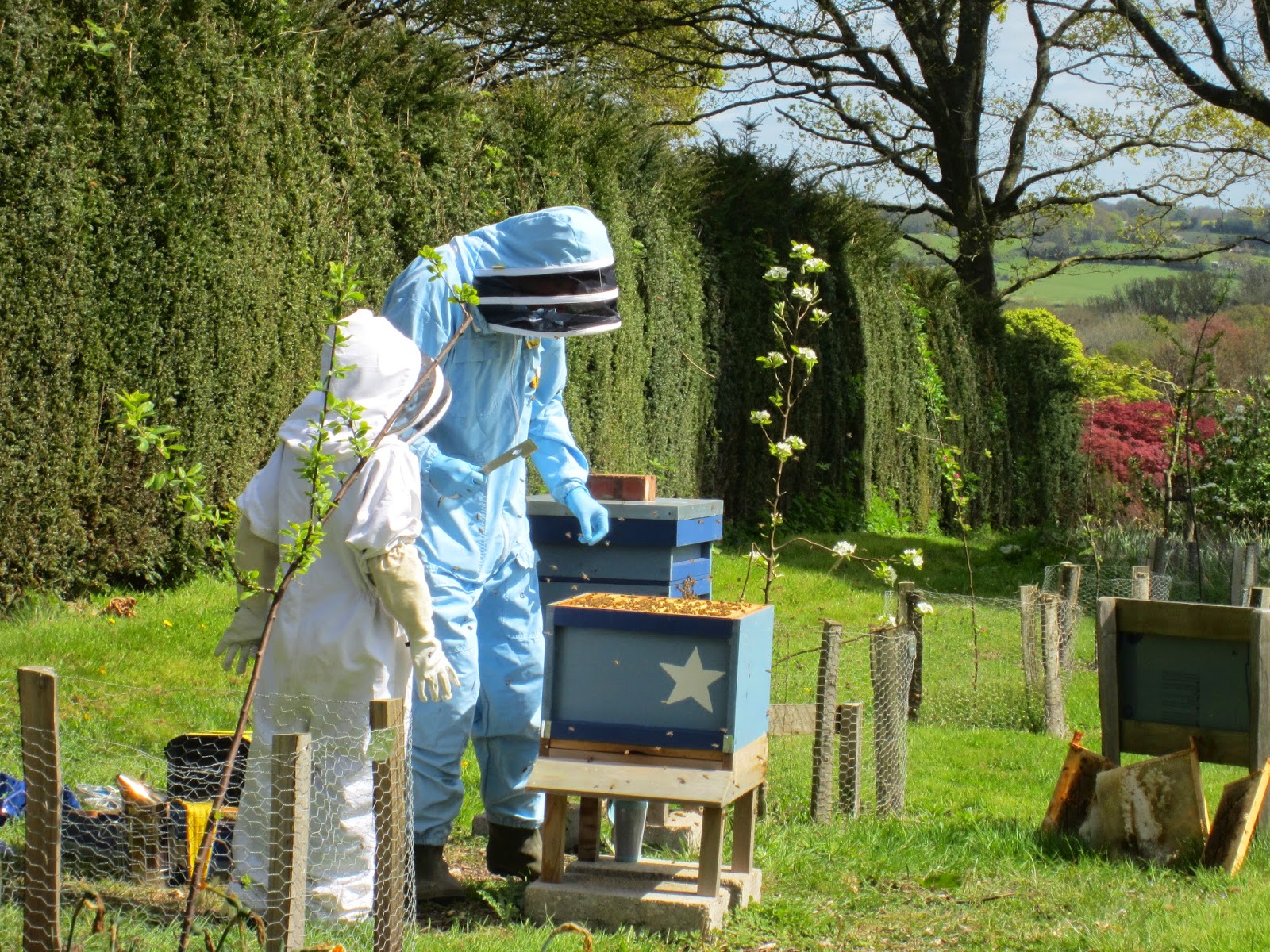
Moon supered up and Star open - but both blue again (like the beekeeper)!

The Moon hive was brimming. Bees were coming out of everywhere and each frame was full with them. And underneath the covering of bees, some frames were completely laid out, with almost no space left for stores. I can certainly understand why they want to swarm.

Lots of bees
A word about swarming: in the wild bees multiply by swarming. If they didn't, they would remain one colony the whole time; by swarming they turn one colony into two, thus increasing their chances of survival. What happens is that when space in the hive gets tight (or they feel like it), the workers will build queen cells and the old queen will lay female eggs in them. By the food they give the larvae, the workers make sure a new queen is reared (in fact, they usually go for more than one queen at any one time, just to be sure). Before the new queen cells are sealed (nine days after laying), the old queen takes half the hive and flies off with it to pastures new - literally. The rest of the colony is left to wait for the new queen to emerge. As you tend to lose half your stores and work force when the queen leaves, as a beekeeper you try to prevent the bees from swarming.
Swarm control and prevention is the true acid test of a beekeeper - and the Moon is about to swarm.
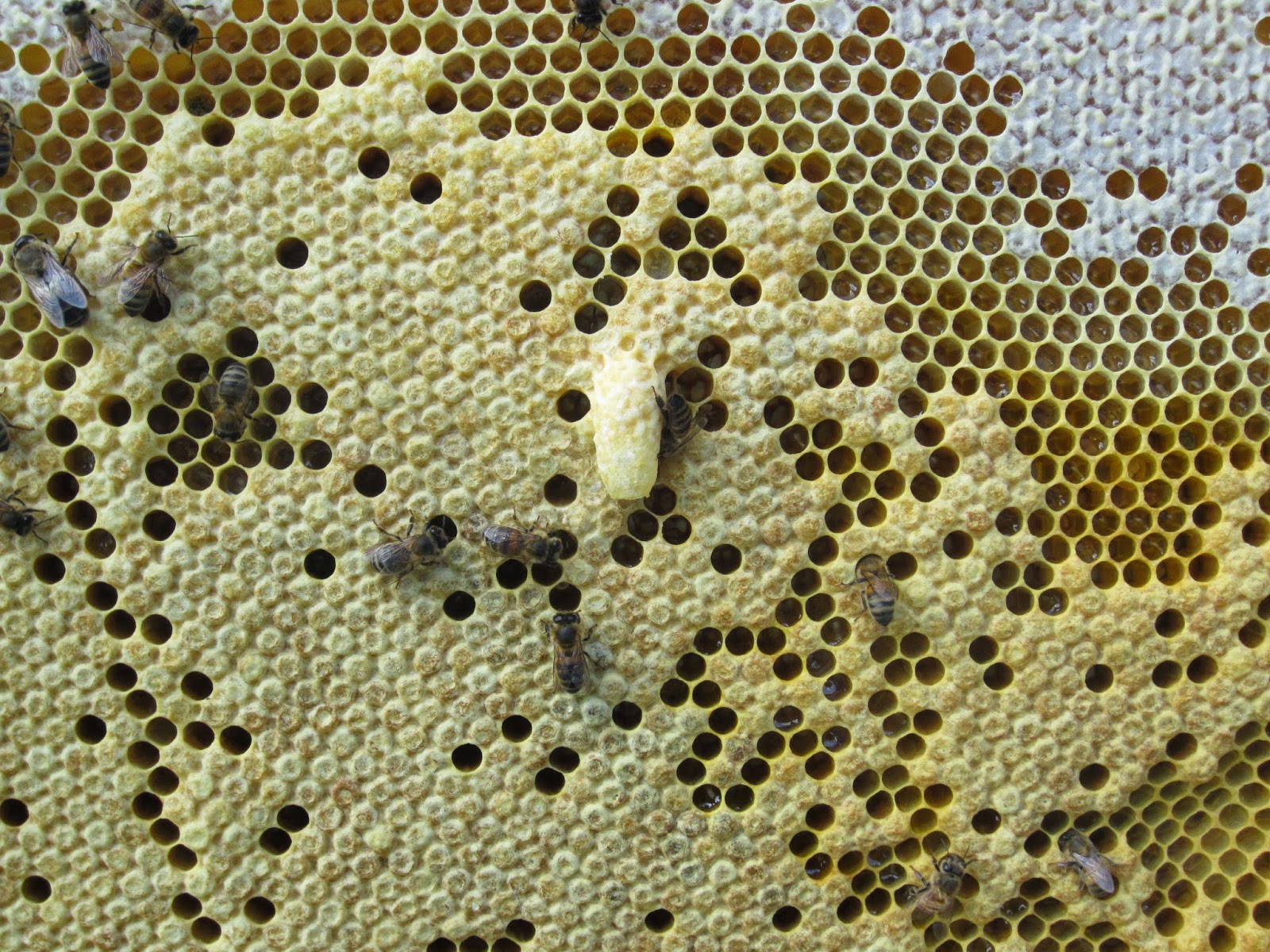

A beautiful queen cell
During the inspection we saw numerous queen cells, strewn all over the Moon, about eight or nine of them. All larger ones had larvae in them. If I had left them like that, the queen would be gone in a day or two. So, I emptied all the queen cells (sorry larvae!), buying me enough time till the weekend, when I will have to do some swarm prevention in earnest. There are a few things I have to prepare as well as lots of reading I have to do till then.
There were also lots of drones in the Moon, another sign that the colony is gearing up to rear queens.

A varroa mite on a pupa
In some broken off comb we saw developing bees, which are a ghostly white. One had a big brown bump, I think on its head. This is a varroa mite; the pesky parasites - hate them!

In another part of comb we saw a number of bees hatching simultaneously.

Synchronised hatching
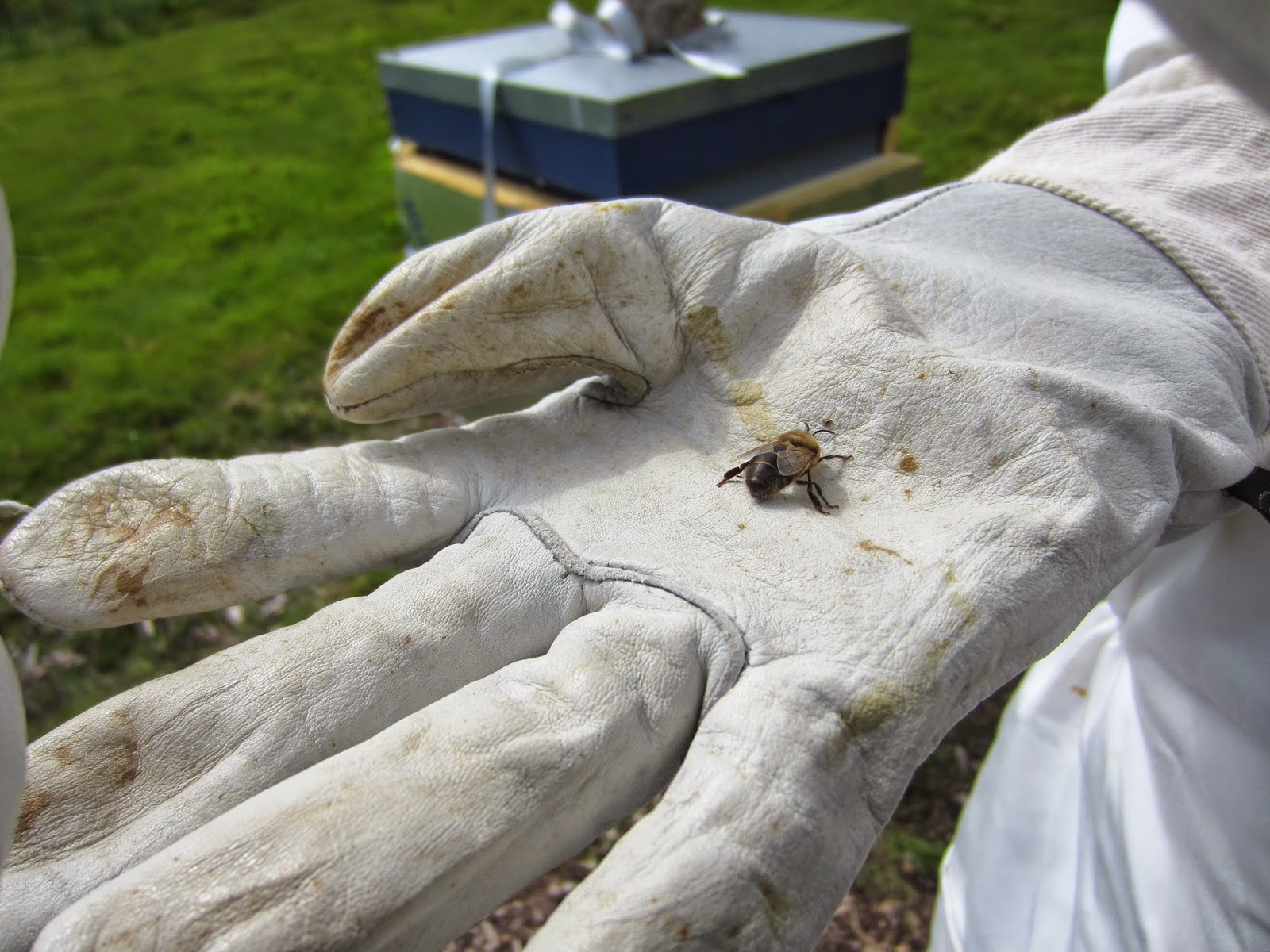
A drone in the hand...
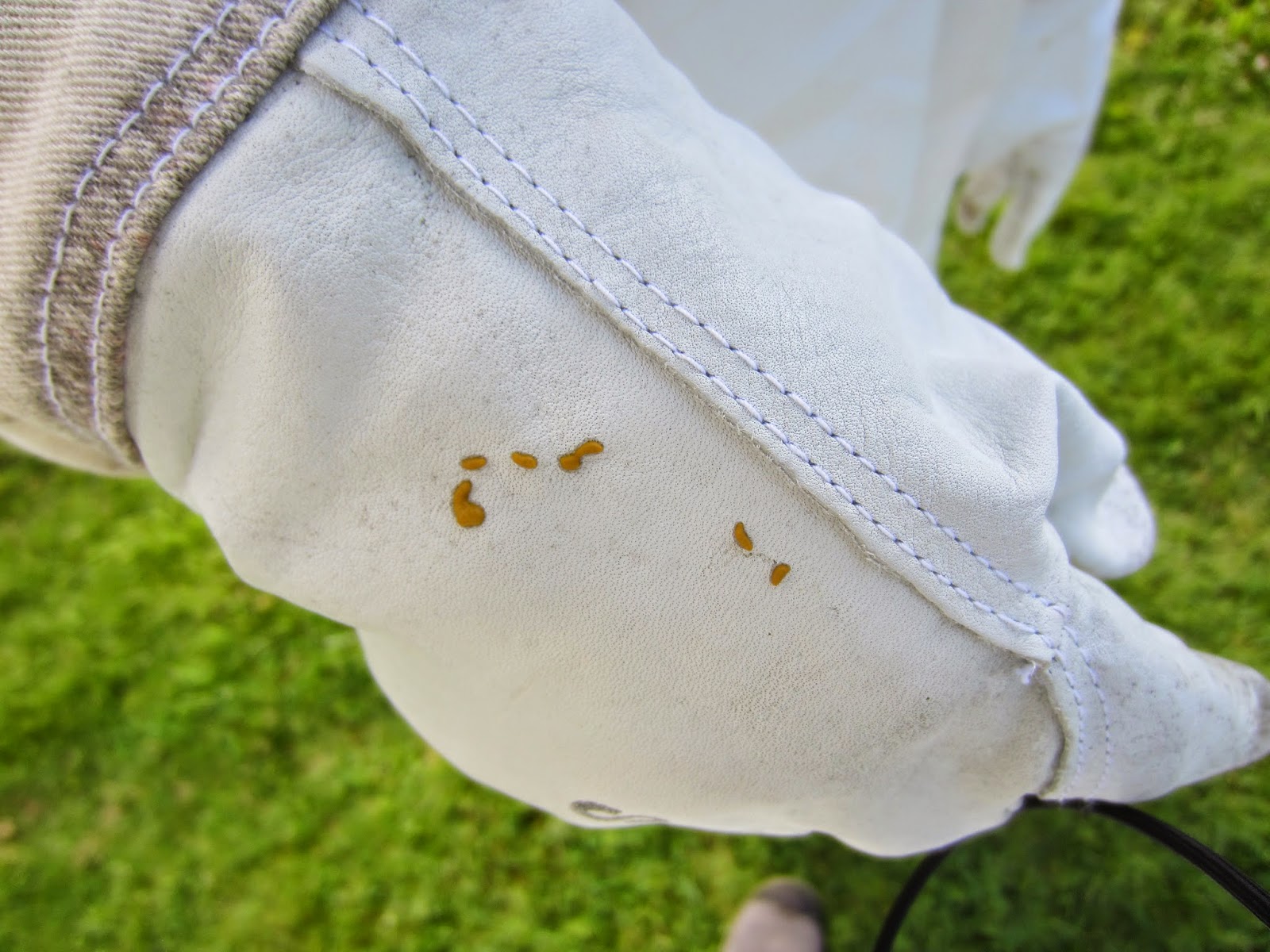
Other highlights of the rather long inspection (as I had to make sure I found all queen cells) were holding drones and finding out how to work a smoker. The eagerness with which the pupils smoked the bees reminded me of altar boys waving frankincense. One of the children was followed by bees only to then have the bees poo over her. With children's enthusiasm for all things scatological, this was quite an event and duly photographed.
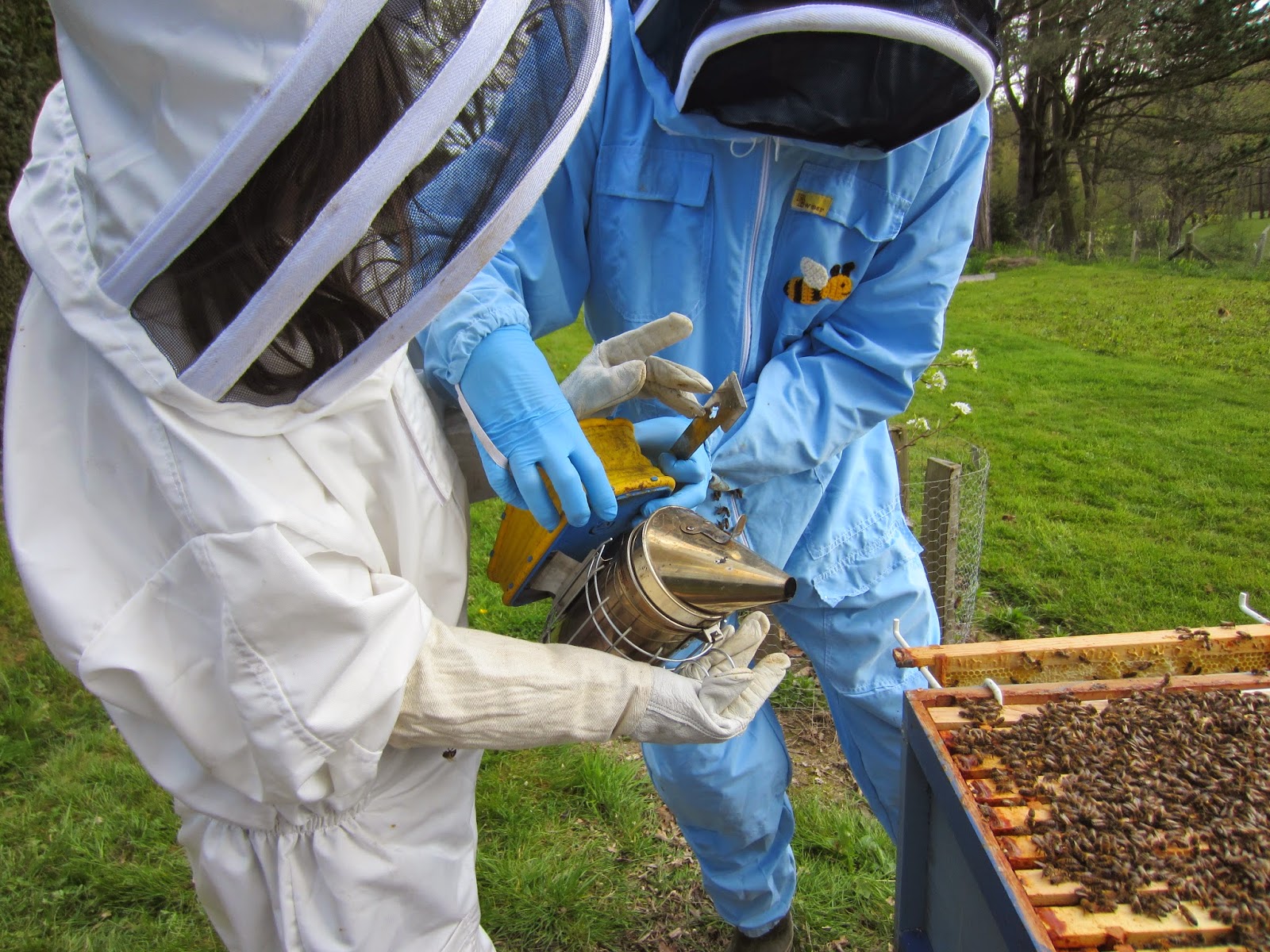
Showing Valerie how to use a smoker


Bee poo


We didn't see the queen in the Moon, but eggs and larvae, so she's still there, hiding, which is easy, unmarked as she is.

Apart from the Moon we also took a quick peek at the Star, which is as it was last week. We saw the queen, which was easy as there were not so many bees and she had a big yellow dot on her back.

Tuesday, 8 April 2014

La Reine est morte - vive la Reine!

Although on holiday, the bees of course are not, and even though it is not prime swarming season yet, I thought it would be good to keep close tabs on the bees as the weather improves. The Moon in particular had looked quite full last time, so I thought a more regular inspection regime might be in order.

Our scribe
It's great that in the school a number of staff have shown an interest in the hives as well. For me it is truly satisfying to be able to involve as many people as possible to make the hives belong to the whole school as much as possible. Lorraine, one of the kitchen staff of the school, wanted to accompany me with her two children; so, together with a friend from Austria, we inspected the hives together. Lorraine kept the records, Petra took the photos and the children, after initial reservations, were ultimately - thank God - enthralled. There is something about the bees that seems to draw in children and fascinate them. Having kept their distance at first, by the time we got to the second hive, the two children couldn't stand close enough.

And this time, no-one was stung (not even me)!

Having learnt from the last time, I made sure to have a smoker. Whether it was the smoker or the weather or the children, I don't know, but the bees were a lot calmer, although there were still plenty of them taking to the air.

Checking play cups for eggs
Main purpose of this inspection was to determine how many frames had brood on them and how many stores. When each frame has brood on them, you know the bees are close to swarming. Therefore, it's important to know where you stand (or how much the bees have covered). As expected (feared?) the Moon only has two frames of stores, one new frame with nothing in it as yet and all the rest was brood. Given this situation, I can imagine the Moon will want to swarm soon. We also found a number of play cups - the bees practising making a queen cell (which is larger than an ordinary bee cell)  - in fact, a frightening number of them. I made sure that none of them had an egg in them (which would have meant the bees were ready to swarm in a few days), but the sheer number of them means the Moon is getting jittery.

But the Moon had a surprise in store for us: by sheer fluke we found the queen, but it was an unmarked, unclipped queen, so a new queen and not the original marked queen I received last year. How, when or why the old queen disappeared and a new one came, I do not know. But the bees seem happy with her, she seems to be laying properly (so has also mated - when did all of this happen?!!?) and the Moon is as strong as ever. I will have to ask more experienced beekeepers what might have happened there. I do not think I have lost a swarm as the Moon as always had lots and lots of bees, so the original queen must have accidentally got lost somehow, sometime and the bees must have then reared a new queen, possibly even last year.

The new Moon queen - unclipped, unmarked and very happy!

The Moon was so busy that I have decided I will super up next time I inspect the bees.

A perfectly marked Star queen
The Star was a much more sedate, as was to be expected. We found the queen (marked), no problem, and saw brood as well as a few bees hatching. In the Star there are still many frames that are stores and only about half that contain brood. Both hives had drones and quite a bit of drone comb in them; the children loved letting drones walk over their gloved hands - there's no risk involved as drones have no stings. The fact that the bees are producing drone comb suggests that they might want to swarm soon, though the risk with the Star is smaller - there were only very few play cups here.

The Star showed a beautiful brood pattern (as did the Moon, actually). What this means is that you have an arc of honey and pollen at the top of the frame and then an elliptical area of brood, which moves out as more and more eggs get laid. The photo below shows this. What this means is that all is fine with the queen and that she is laying normally. So, a cause to smile and quietly thank her and the bees for doing so well.
A perfect laying pattern, with stores in an arc at the bottom,
some space to expand and the brood in a tight ellipse

In fact I am hugely grateful to the bees for being so
industrious and calm. All in all a very successful - and interesting - inspection which the children loved. And if they go away enthused by the bees and tell their friends, then more and more people will come to see what lovely and helpful little creature bees really are.

Trigger-happy bees

28th March 2014

I have fallen a bit behind with my blog updates and what I am writing here is the inspection I carried out with three pupils on the last day of term. We had a window of about an hour before prize-giving and I thought that should suffice to have a quick look at both hives. We did manage to look into both hives and make it in time for end-of-term prizes, but only just.

The Moon looking deceptively sedate
Once again I had the head of science, Richie, as a helper (he is becoming a keen beekeeper himself, which is great and bodes well). This time the bees were somewhat more excited (which may have to do with the fact that I didn't use a smoker again; have decided that with children around it's probably best to use a smoker, if only as a placebo, as they can get nervous and then having a response to the bees is useful) and showed a great interest in Richie and the camera and it was not long before he was stung. After that the inspection seemed to turn into a free-for-all sting-fest, with most pupils getting stung (though not badly, as through leather gloves or several layers of clothes); the only one who remained unscathed was yours truly. This was the first time the pupils were stung - and the first time I wasn't.


Bomber bee!
So - what did we see?
The Star queen seems to be a lot easier to spot these days and we saw her, yellow dot shining. But we saw eggs in the Moon, which means the queen must be there in hiding, laying away quietly. We also saw some bees emerging from the comb. As last year, the Moon is ahead of the Star - the Moon has more bees and is busier.

The bees still have plenty of stores and both queens are busy laying, though the Moon has more frames of brood than the Star. In fact, I have the feeling the Moon is close to capacity and will have to check that more carefully next time.

We kept the cladding on as the weather is still not reliably clement (Ha! Is it ever?).


Monday, 7 April 2014

Bee stings

We all know bee stings are uncomfortable and, as regular readers of this blog will know, I have been stung numerous times, most spectacularly in the lip. However, I have never had the desire to find out where the most painful place to be stung by a bee might be. Someone else has had that idea and went about his research with methodical madness. The link to the findings are here.
Ouch!

Sunday, 16 March 2014

Star shining

On Friday, 14th March I inspected the Star and did to it all I did to the Moon, more or less. I was accompanied by another teacher, but again no children. I guess the rehearsals for the school play got in the way.

So it was just the two of us. I dispensed with the smoker, again, and it did not seem to matter at all. The bees were calm, good-natured and, if I may indulge in a little fantasy, pleased to see me. Lifting up the whole hive to put in the bee gym was quite a task, but my workouts at the gym are obviously paying off. Lifting up the hive dislodged the entrance bar and luckily I spotted that just before we left, or else the hive would have been open to any passing marauder.

What's under the roof?
Opening up the Star, the bees had built comb over the frames, much like the Moon, though less artistically. I think the reason they built it there is to have more stores near the brood, as the new comb was directly over the frames containing brood.


The Star have more of a sweet-tooth than the Moon as more of the fondant was gone. And although one whole frame side was empty of stores, the Star, too, has sufficient stores to not need the fondant anymore. I took it away and had it gift-wrapped by the kitchen staff (who have a brilliant, industrial-kitchen sized cling-film wrap dispenser) ready for next year.
Bee egg hunt


The Star queen has also started laying and is following the same pattern as the Moon queen, with the brood located towards the entrance side of the frames. We actually saw the queen (as well as brood and eggs), who was doing her best to appear unobtrusive, but for her yellow spot and also saw a couple of worker bees emerging from their cells, other bees happily stepping over them as they hatched. I managed to exchange one short store frame for a long empty - using similar scratch tactics as with the Moon.

Long live the queen!
Am very pleased with the Star, too, that has also survived the winter well and is now colony building. Kept the celotex cladding on the Star and refitted it on the Moon and will keep it there till the end of March.

Thursday, 13 March 2014

Moon take-off

With the weather improving, I thought I'd take a look to see what the bees are doing. As there were a number of jobs that needed doing, I decided to inspect each hive on a different day, starting with the Moon. This would also increase the number of pupils that could come out to see the bees.

However, Wednesdays are match days, so there were in fact no pupils that came out. Hrumpf! So much for wanting to involve more pupils. The first full inspection of the new season was therefore a very quiet affair: just another teacher and I.

If truth be told, I was slightly apprehensive about the first inspection. Have browsed through photos from last season, I realised again how many bees there are in the hive. I was a bit worried that I wouldn't be up to it, that I might panic, that the bees might be unsettled. Nothing of the sort. The bees were sweet as ever (I do love them!) and were unruffled by me putting my fat (well, not really) fingers in their home. I didn't even use a smoker (just had it ready as a back-up, in case), and they were lovely and calm.

The latest skyrise at Bee Wharf
So what did we do? We checked stores (lots and lots: at least four frames front and back still full of honey or syrup), checked for the queen (whom we didn't see, but lots of eggs and larvae, so she is busy laying), removed the cladding, the mouse guard and the fondant, put the bee gym in the bottom of the hive and re-jigged some frames. I am still battling with the fact that the original nucleus came last year with too short frames. This time I took out two short frames with honey stores and replaced them with fresh long frames. This should keep the bees busy (they are showing ambitious architectural tendencies: when I opened the hive, they had built a honeycomb dome and were busy trying to build more) as well as bring a bit more order to the hive. The honey will not be lost, as I left the frames in front of the hive, slit open, so the bees can find the honey, collect it and store it (again). I wonder how much of the outside honey will be left tomorrow, when I go to inspect the Star.

Scratched comb stores waiting to be collected (again)


Have just seen the weather report. Apparently there are sub zero temperatures coming our way again. Will replace the cladding on the Moon tomorrow, when I inspect the Star. Don't want the little darlings to freeze.

Thursday, 6 March 2014

Going to the gym

Although I am one of the madder part of humanity, which spends far too much time in a gym in an unlikely attempt to get fit, the title is not about me, but about the bees. Today two contraptions known as 'bee gyms' came through the post. Various modules are spread out on the square frame where the bees, by climbing through them, scratching past them or rubbing over them, can remove varroa mites. Apparently they like this and will use the gym (although in my humble opinion the gym is more a scratching post than a gym). While I am slightly skeptical, I am also prepared to try anything that might keep the varroa count down. So next time I inspect the hives - first inspection of the year, with pupils, of course! - I will add these little pieces of health equipment.

Parallel bars, wooden horse, frames and scratching areas - all in a bees' gym

Monday, 3 March 2014

Hang 'em high!

Space invaders
Beesuits are unwieldy at the best of times, but for children they seem to present an utter labyrinth of clothing mayhem. It starts with the pupils having boots on already to get to the apiary and then trying to get the beesuits on without taking the boots off (has no-one told them you put shoes on after trousers?!?). Then as the suits are large and flappy, they tend to trail them over the floor of the shed or the ground outside. With the muddy weather over the winter this has meant that the inside legs of the beesuits as well as their exteriors have become soiled. So, before the new season gears up and becomes hectic, I thought I'd wash the beesuits. I added plenty of soda crystals to the powder, because apparently that can get rid of the propolis easily.

Hung the four suits up to dry. Luckily that was not in my bedroom. Can imagine waking up at night and suddenly thinking four people have invaded my room before realising it's only the suits. Can do without that kind of interruption to my scant repose. Need to do better than sleep fitfully, as a wise friend of mine would correctly remark.