As reported, I had slid varroa boards into both hives a week ago and I checked them today. Although the Star is broodless, it still had quite unhealthy numbers, but the real surprise was the Moon, that had been such a star last year. Despite the fact that it had a broodless period, too, during which - surely - mite numbers must have depleted, the varroa obviously felt at home there and reproduced at almost alarming levels. Also, I guess because I wasn't able to remove any drone comb, as I did last year, the varroa had a nice, undisturbed time.
Now, maybe I'm miscounting: there are an awful lot of 'empty' mites (just the back shells) and very light ellipses that don't seem to have legs, but I put them all down as varroa - better safe than sorry, I reckon.
Given the tallies (Moon: 134 mites in 6 days, Star 54 in 6 leading to daily drops of 22 and 9 respectively), both will be getting the Apiguard treatment as soon as the honey is off.
Darn those mites!
Monday, 25 August 2014

Sunday, 24 August 2014
Queen check
Today was a beautiful day, so I went to check up on the Star and Moon - the final inspection before the honey is taken off.
Lots of bees in the Moon that are working on the third super. Two supers are heavy with honey (the new low hive position does my back no favour and I'll be glad when they are on new stands again). The (invisible) queen is still laying and the laying pattern is good. As drones have been setting me riddles in the Star, I immediately noticed that the Moon has no drones. The Moon bees are obviously getting ready for the winter and have thrown the drones out. Or are the drones mating with the Star queen? I suspect the former. Drone comb was also empty and unegged.
The bees were lovely and calm and didn't sting me at all. When I'd reassembled the hive, the bees all buzzed contentedly, the wood reverberating to the lovely sound.
The Star had fewer bees, but was looking much neater again. Although more defensive, the bees were actually also very sweet and calm. A few drones hung around, but not that many. As feared, there were no eggs, let alone larvae. So the queen (I'm pretty sure there is a queen, as the colony is so calm and collected) has not mated successfully yey. Not sure she will. Question then is what happens to her? Do the workers then throw her out as she's infertile? Will have to read up on that, but am thinking that over winter I'll probably bring about some astronomical conjunction and unite Moon and Star. Can't do that safely though if I have a queen crawling around the Star.
Will continue to check the Star and take my cues, as always, from the bees.
Lots of bees in the Moon that are working on the third super. Two supers are heavy with honey (the new low hive position does my back no favour and I'll be glad when they are on new stands again). The (invisible) queen is still laying and the laying pattern is good. As drones have been setting me riddles in the Star, I immediately noticed that the Moon has no drones. The Moon bees are obviously getting ready for the winter and have thrown the drones out. Or are the drones mating with the Star queen? I suspect the former. Drone comb was also empty and unegged.
The bees were lovely and calm and didn't sting me at all. When I'd reassembled the hive, the bees all buzzed contentedly, the wood reverberating to the lovely sound.
The Star had fewer bees, but was looking much neater again. Although more defensive, the bees were actually also very sweet and calm. A few drones hung around, but not that many. As feared, there were no eggs, let alone larvae. So the queen (I'm pretty sure there is a queen, as the colony is so calm and collected) has not mated successfully yey. Not sure she will. Question then is what happens to her? Do the workers then throw her out as she's infertile? Will have to read up on that, but am thinking that over winter I'll probably bring about some astronomical conjunction and unite Moon and Star. Can't do that safely though if I have a queen crawling around the Star.
Will continue to check the Star and take my cues, as always, from the bees.
 |
| Both hives showing signs of activity |
Monday, 18 August 2014
Bee- and housekeeping
Main purpose of today's inspection was to ascertain whether there was a mated queen, a waiting-to-be-mated queen or complete chaos in the Star hive. I also thought a bit of housekeeping would not go amiss to try and remove as many traces of the collapse as possible.
Before doing any of that, I got some nice new varroa boards, which I battleshipped to better be able to count the mites when they drop. The old wooden boards warped too easily and much; these plastic ones will hopefully last longer.
The Star is still fairly quiet. Having looked at the bees again, I don't think a swarm left as there are still many bees - just not as many as if the queen were still in lay. I was pleased to note quite a number of drones in the hive, lending strength to The Captain's theory that the workers got nervous, threw a hissy and their stingers around and got a few drones. Makes me think of Hall&Oates: Watch out boy, she'll chew (or sting) you up, she's a bee-eater (well, not really, as they do exist and are quite different, being birds for starters).
Anyway, no eggs, no larvae, plenty of stores. Couldn't see the queen, but suspect she's around as the colony was calm and collected. Will continue monitoring it closely, though.
We removed one whole super full of frames where the foundation had been damaged beyond repair. Should probably have done that earlier. Also checked super full of capped honey and the bees have obviously done their housekeeping, too, as all combs are in pristine condition again; no trace of squashed bees. Bees are so hygienic; wish I had one as a housekeeper at my place!
On some of the damaged frames we removed there was still some capped honey, so we allowed ourselves a small treat after the beekeeping was done.
Also put a wasp trap out, as quite a few of these horrible flying menaces were around.
Before doing any of that, I got some nice new varroa boards, which I battleshipped to better be able to count the mites when they drop. The old wooden boards warped too easily and much; these plastic ones will hopefully last longer.
 |
| Ready to play mite battleships |
The Star is still fairly quiet. Having looked at the bees again, I don't think a swarm left as there are still many bees - just not as many as if the queen were still in lay. I was pleased to note quite a number of drones in the hive, lending strength to The Captain's theory that the workers got nervous, threw a hissy and their stingers around and got a few drones. Makes me think of Hall&Oates: Watch out boy, she'll chew (or sting) you up, she's a bee-eater (well, not really, as they do exist and are quite different, being birds for starters).
Anyway, no eggs, no larvae, plenty of stores. Couldn't see the queen, but suspect she's around as the colony was calm and collected. Will continue monitoring it closely, though.
We removed one whole super full of frames where the foundation had been damaged beyond repair. Should probably have done that earlier. Also checked super full of capped honey and the bees have obviously done their housekeeping, too, as all combs are in pristine condition again; no trace of squashed bees. Bees are so hygienic; wish I had one as a housekeeper at my place!
On some of the damaged frames we removed there was still some capped honey, so we allowed ourselves a small treat after the beekeeping was done.
 |
| The benefits of beekeeping |
Also put a wasp trap out, as quite a few of these horrible flying menaces were around.
Saturday, 16 August 2014
Outside hive advice
The great thing about the net is that people far away can take a peek at what I've been doing and then pass on their experience. I was lucky enough to have The Captain, master of all things bee related with more than 30 years' beekeeping experience, have a look at my drone problem (thank you for taking the time and for your advice!) and what he writes is (paraphrased) this:
Drones would not try to mate with a queen inside the hive.
In instances of high stress the workers will kick the males out of the hive because of limited resources. So the males were stuck in the gaps of the queen excluder because they were trying to escape the stingers of the workers. When a bee stings another bee the barbs do not usually force a break in the abdomen, so the stinger will not usually remain stuck in the stung bee, as it happens with skin, so you would not see a trace in the drones.

The workers, I guess, would undoubtedly be stressed, losing a queen this late in the season (not to mention the upheaval of having the hive fall over and then having it righted again when they had got used to the fallen state), so the explanation makes sense and fits how we found the drones. However, the hive has enough stores for the drones not to be a drain on resources - yet (but perhaps the bees are already preparing for winter). Also, if they are rearing a new queen surely they would need drones to mate with her?
The next inspection will hopefully throw more light on the matter.
Drones would not try to mate with a queen inside the hive.
In instances of high stress the workers will kick the males out of the hive because of limited resources. So the males were stuck in the gaps of the queen excluder because they were trying to escape the stingers of the workers. When a bee stings another bee the barbs do not usually force a break in the abdomen, so the stinger will not usually remain stuck in the stung bee, as it happens with skin, so you would not see a trace in the drones.
The workers, I guess, would undoubtedly be stressed, losing a queen this late in the season (not to mention the upheaval of having the hive fall over and then having it righted again when they had got used to the fallen state), so the explanation makes sense and fits how we found the drones. However, the hive has enough stores for the drones not to be a drain on resources - yet (but perhaps the bees are already preparing for winter). Also, if they are rearing a new queen surely they would need drones to mate with her?
The next inspection will hopefully throw more light on the matter.
Wednesday, 13 August 2014
Drone death
Having tidied up the Star and put the Moon onto firm foundations, I really should have checked up on the hives end of last week or at the weekend. I did not think it was really pressing (having forgotten everything I sort of knew about queen rearing), and as I have my daughter round, who is not too keen on the bees, and also wanted to once again have the excellent services of my fellow teacher and super-hero Goulwenn, I didn't go till today. Not sure that much was lost, but possibly...
First things first: the Moon is doing fine. However, although the bees are collecting in the third super, nothing is capped yet. As the season is getting late, I doubt we will get much more honey than the two supers. If I had been able to put the third super on earlier, there might have been more to harvest.
The Star is still marked and suffering from the aftermath of the fall. All the honey in one super is gone. It really does look like a war zone.
 Very few bees were in the supers, which led me to conclude that I must have accidentally killed the queen when I tried setting things aright last time. Memo to future: get the queen out first and put her in a safe place before you start cutting swathes through the hive. Live and learn.
As expected we found a number of empty queens cups on various frames: two conspicuously large and just as empty. Possibly, the first queen to hatch left the hive with a small swarm. Although this would not make much sense, as the season is late and that swarm would almost certainly be doomed, the very small number of bees suggest this may have happened. If I had inspected earlier, I could have prevented that. Always, always work to the animals' needs. Really have forgotten basic principles.
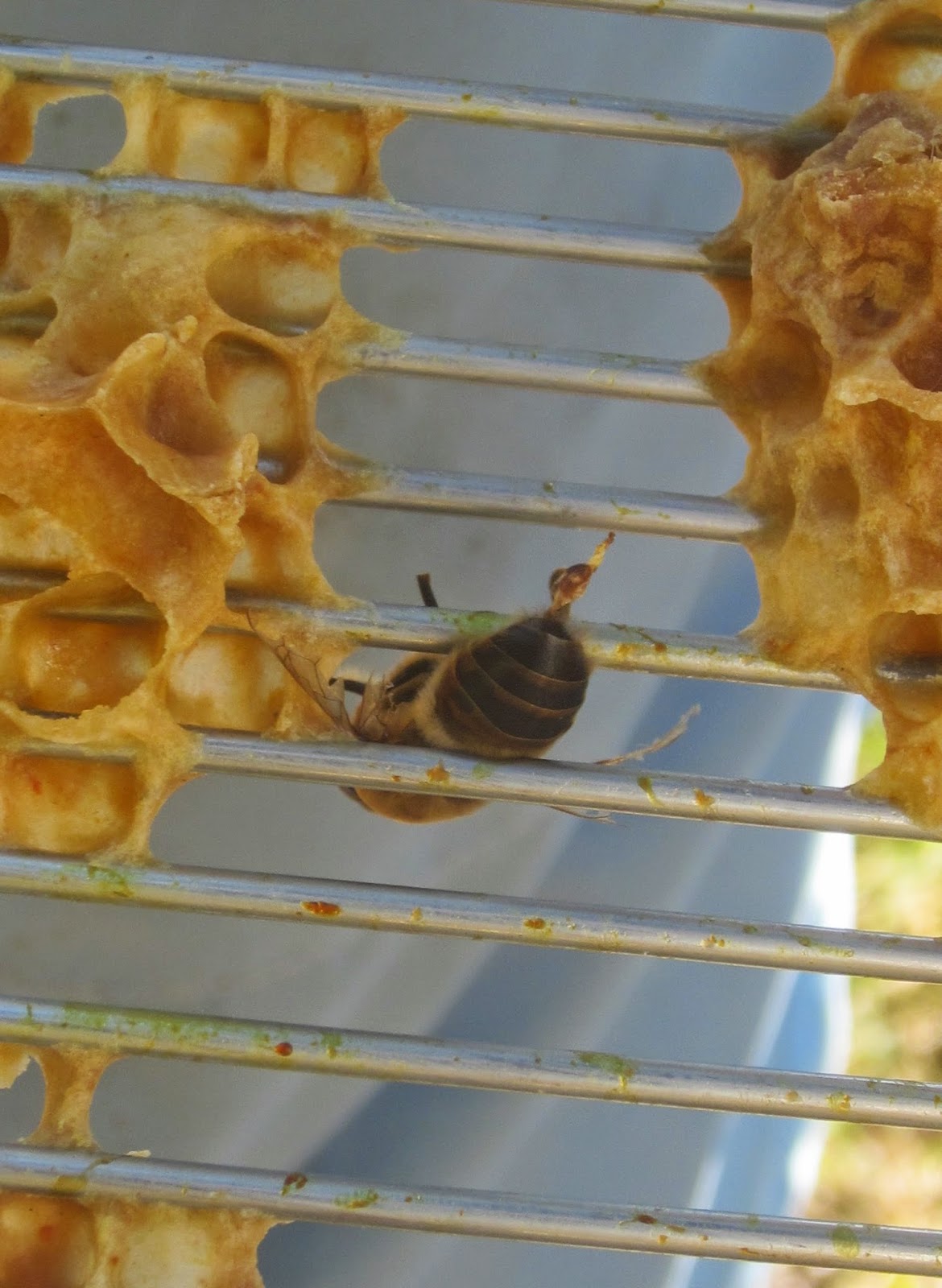
But the weirdest thing was that under the queen excluder was a whole heap of dead drones. Even more weirdly, many were stuck in between the gaps of the excluder. Now drones, being larger, don't fit through the excluder, but I've never known this to be a problem; I've never seen drones stuck in the gaps of the excluder before. Why were they so desperate to get through? There are plenty of stores in the brood box, so it wasn't hunger driving them to trap themselves. Also - why did they die? Goulwenn and I saw strange protrusions from their abdomen and formulated weird theories of bee group sex with the new virgin queen in the darkness of the hive, against the rails of the excluder - something like that.
However, when I checked in my bee books, I realised a drone's reproductive parts look nothing like that, not even after they've burst off after copulation. So the mystery remains: why are the drones there and what have they got sticking out of their backsides? Perhaps their guts bursting out of their bums from the squeeze?
While I could theorize that the virgin queen, while still slim, may have slipped through the excluder and the drones wanted to follow her, this also doesn't tally as the drones and queen live side by side in complete harmony in the hive and it's only during the mating flight that the queen releases pheromones that get the males all going for her.
Will be going to inspect again soon, to see whether the Star has a mated, laying queen. If not, I shall have to amalgamate it with the Moon for the winter.
So, while things are looking up for the Star, everything is still far from ideal. Hey-ho, that's the way it goes. Not a great year for honey due to various traumata (though it should have been), but as long as the bees pull through fine...
Oh, and having fully functional legs (and brains!) would be nice, too.
First things first: the Moon is doing fine. However, although the bees are collecting in the third super, nothing is capped yet. As the season is getting late, I doubt we will get much more honey than the two supers. If I had been able to put the third super on earlier, there might have been more to harvest.
The Star is still marked and suffering from the aftermath of the fall. All the honey in one super is gone. It really does look like a war zone.
As expected we found a number of empty queens cups on various frames: two conspicuously large and just as empty. Possibly, the first queen to hatch left the hive with a small swarm. Although this would not make much sense, as the season is late and that swarm would almost certainly be doomed, the very small number of bees suggest this may have happened. If I had inspected earlier, I could have prevented that. Always, always work to the animals' needs. Really have forgotten basic principles.
 |
| A drone's - what? |
But the weirdest thing was that under the queen excluder was a whole heap of dead drones. Even more weirdly, many were stuck in between the gaps of the excluder. Now drones, being larger, don't fit through the excluder, but I've never known this to be a problem; I've never seen drones stuck in the gaps of the excluder before. Why were they so desperate to get through? There are plenty of stores in the brood box, so it wasn't hunger driving them to trap themselves. Also - why did they die? Goulwenn and I saw strange protrusions from their abdomen and formulated weird theories of bee group sex with the new virgin queen in the darkness of the hive, against the rails of the excluder - something like that.
 |
| A drone's sexual organ |
While I could theorize that the virgin queen, while still slim, may have slipped through the excluder and the drones wanted to follow her, this also doesn't tally as the drones and queen live side by side in complete harmony in the hive and it's only during the mating flight that the queen releases pheromones that get the males all going for her.
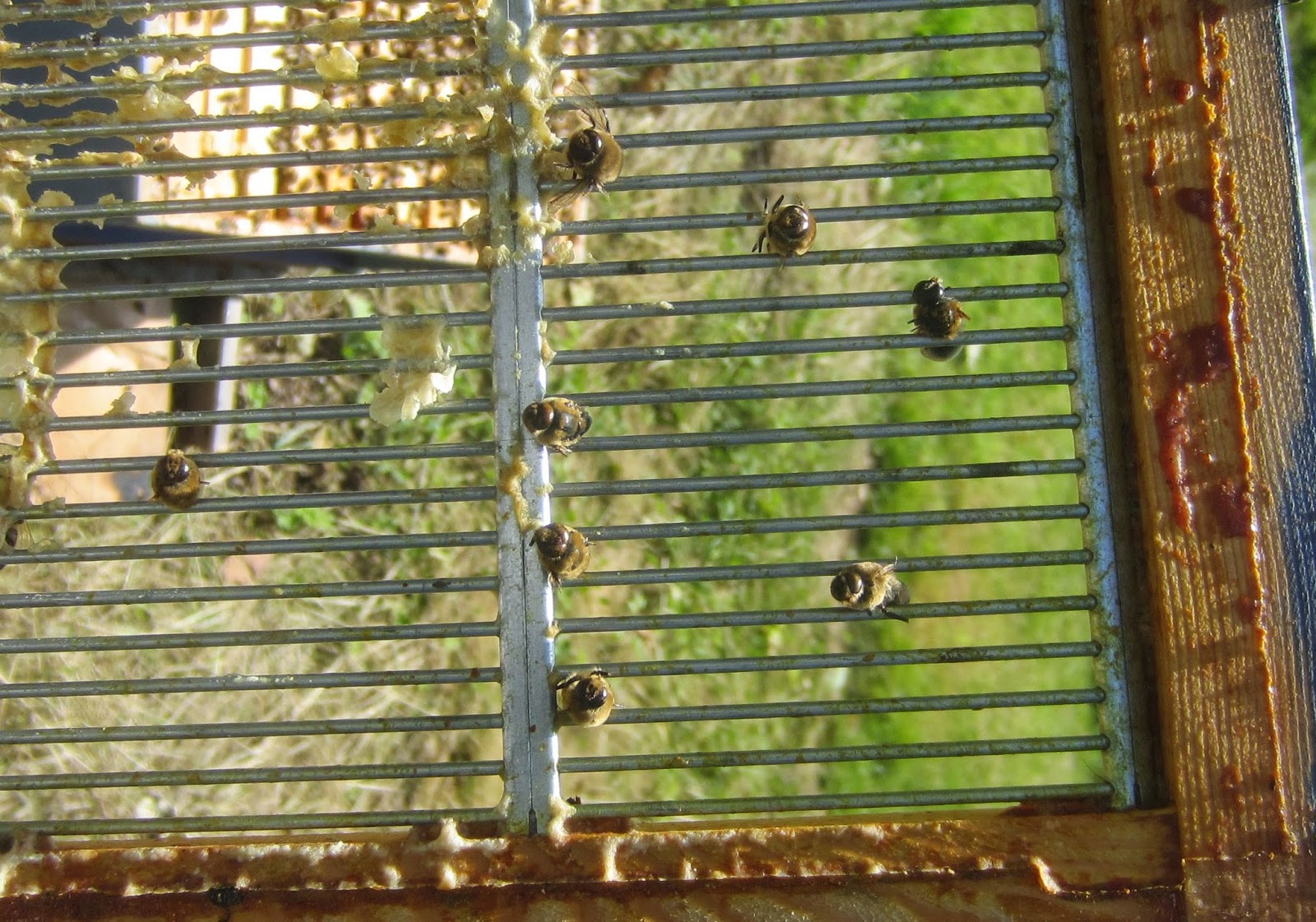 |
| Drones plugged through the queen excluder much like the gulls in 'Finding Nemo' |
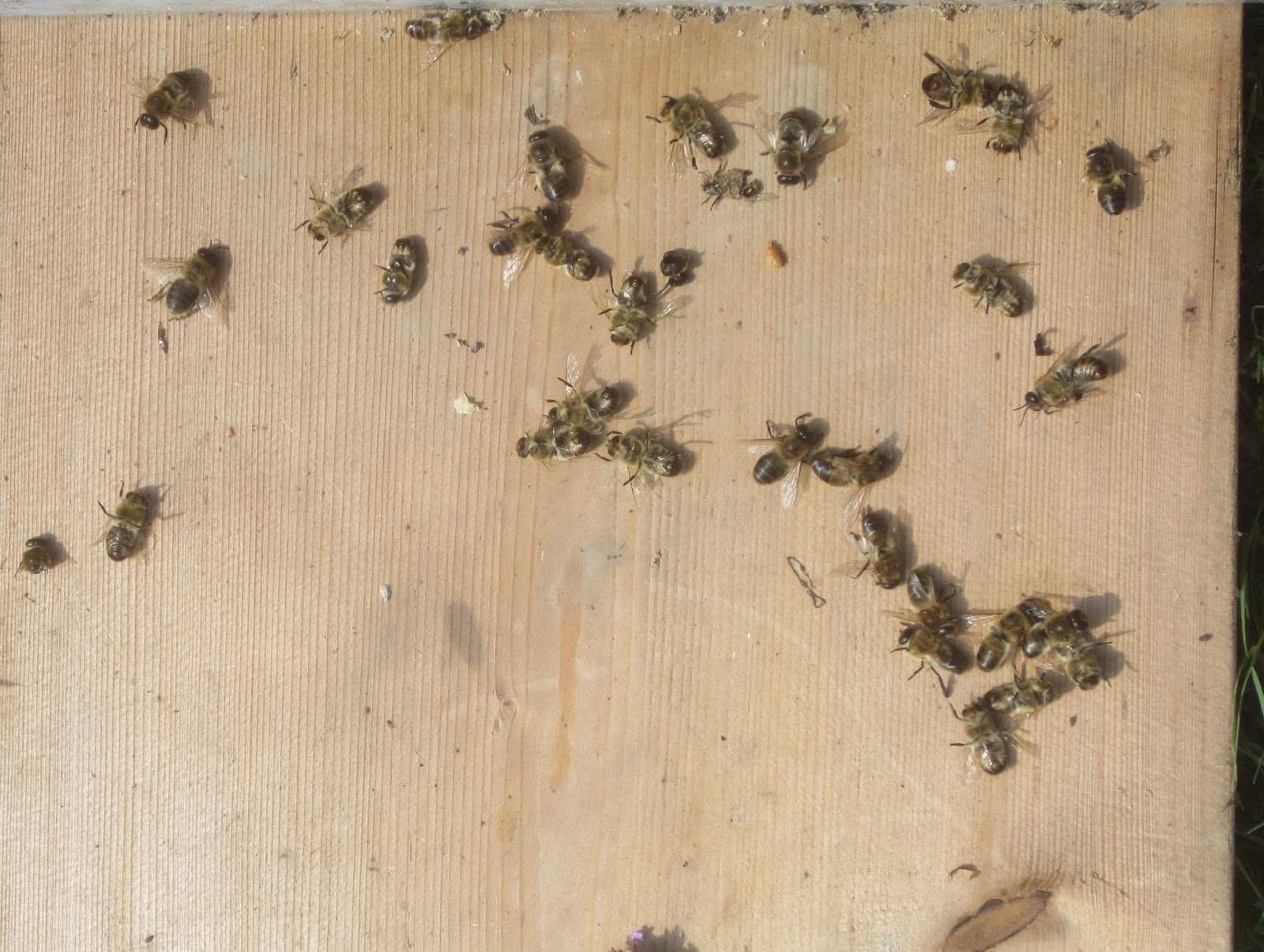 |
| A lot of shot-down drones |
Will be going to inspect again soon, to see whether the Star has a mated, laying queen. If not, I shall have to amalgamate it with the Moon for the winter.
So, while things are looking up for the Star, everything is still far from ideal. Hey-ho, that's the way it goes. Not a great year for honey due to various traumata (though it should have been), but as long as the bees pull through fine...
Oh, and having fully functional legs (and brains!) would be nice, too.
Thursday, 31 July 2014
Taking a stand
 |
| G - l'ange en blanc |
 |
| The old stand is definitely askew when compared to the hive now |
 | |
| A bee desperate to get captured on film, possibly to prove that bees can have wasp waists, too; they always show an undue interest in the camera, sometimes making taking photos almost impossible. |
ERRATUM: In my last post I wrote that G received 7 stings to his ankle. Today I was told it was more like 10, although neither one of us counted precisely.
Tuesday, 29 July 2014
Bee-saster
I was going to inspect the bees either today or tomorrow, but received an email from one of the groundsmen in the school that one hive had fallen over. So what I thought would only be a leaning tower actually fell down. A nightmare.
Luckily, and truly luckily, a member of staff (who I shall name G), who lives more or less on site, offered to help me sort out the mess and together, after many stings, we got everything up and running again.
But first things first.
Pre-warned by the email, I didn't bother to take a smoker to the Star, but did decide to wear the leather gloves. Quite rightfully the bees were going to be in a foul mood and smoke would not calm them in any way - maximum protection was the only way forward. Well, G unfortunately did not quite go for maximum, wearing only ankleboots, which he soon rued, when ten bees made themselves uncomfortable in his boots. All credit to him that as soon as he had taken off the offending boot with three surviving bees, he procured some wellies and returned to help me.
The sight that greeted us was horrible.
The supers and broodbox were on the ground, all in awkward positions. A lot of the capped honey had broken out of the frames, many bees had been squashed against stores, so that most of the honey frames looked like squashed fly biscuits (though it was a case of squashed bees). Bees, wasps and slugs were all over the debris of the super frames, the roof was damaged considerably and the hive stand had collapsed.
In fact, it was probably a rotten or weak hive stand that led to the hive falling down rather than unevenness in the floor, though this wouldn't have helped.
First thing I did was to get all boxes the right way up and in various places where they wouldn't be in the way, so I could sort through them. Priority was the brood box, which I managed to place on two plastic flower tubs. The brood frames were all aslant and stuck down in this position. The dummy board was so stuck down that the top broke off the board, leaving me empty-handed. So I prised a frame from the middle out: what a mess! I removed all frames and then put them back in, but eliminated all short frames, because the comb the bees had built on to the bottom of these had become stuck onto other frames. While dealing with this mess of wax, brood, bees and honey - close to despair, I might add - I may have accidentally swatted the queen aside, with uncertain fate. I thought I saw a green dot disappear somewhere. Having taken all the frames out, I was in for a surprise: where the frames left a cavity, due to the angle they lay in the brood box, the bees had built up comb and had quite a bit of honey stored there. I junked it all. Much like with the queen, I should have been more careful, probably collected it in a plastic ice tub, if only for my own delectation. But in a nightmare scenario like that one, I only wanted to get the bees back on track. If ever that should happen again, I might be better prepared.
While I was doing this, heroic G returned, richer by a pair of wellies and seven stings in one ankle. Unperturbed, he started fixing the stones on which the hive stand had been placed. It was impossible to get this straight, so we settled on a construction that seemed stable, if not level. G's inventiveness in this area was remarkable and he wheelbarrowed various bits of wood and metal to the apiary, which we assembled jigsaw-style to a hopefully firm foundation.
A lot of the honey stored in the supers was broken. I put as much back as I could and hope the bees will sort it all out. The new super I put on before my holiday to Spain had only been drawn out, but has no honey in it. So the bees will hopefully collect some honey in that.
The Star is standing again. The broodbox has three new 12x14 frames in it, but is otherwise unchanged. Hopefully the queen is in there, too. The two old supers are probably useless for honey harvesting, as they've been god knows where with god knows what all over them. I will probably leave them for the bees, but it will depend on how (if!) the bees clear them up.
What makes the whole incident so frustrating is that the Star was obviously doing really well. The queen was good, laying well and the bees, from what I can see, are a good mixture of dark and light, which means they should thrive and collect lots of honey.
After having sorted out the Star, G and I were thoroughly drained and drenched, but decided to check up on the Moon, too. What's done is done, after all.
Glad to say here everything was fine, more or less. The bees have not spared with propolis in the two months they've been alone and getting each separate storey off was a challenge. They have also obviously forgotten that periodically the roof gets ripped off their house, the rooms get shifted around and they are expected to behave while this is happening. They were quite sting-y and excitable. Due to the fact that they were pressed for space before I supered up, they had built comb between the supers, which I broke, but didn't remove, as I thought I'd do this when I harvest. We didn't see the queen, but we did see a beautiful laying pattern with many eggs. The queen seems to be in good lay and the colony as a whole looks strong and healthy. They have also drawn out the new super and started to store some nectar there.
We had a huge amount of mess in the apiary: damaged frames, comb, dead bees, newspaper, honey - you name it - it was there (well, if it had to do with bees: no cakes or haircurlers). Although maybe I should have salvaged some of the wax or the wood (I know it's all precious), I just wasn't prepared for that and threw it all away. Also, I really couldn't face sifting through all that gunk with bees dive-bombing us, and so we bagged it and binned it. We left the apiary as clean as we could and I hope the bees can sort out the rest. I have faith in the Star and am sure the bees there will do a great job. The Moon looks slightly wonky and now I'm worried that may go, too. Surely not...
What a day!
And thank you G: without your heroic help I would have taken one look at the apiary and just cried.
Luckily, and truly luckily, a member of staff (who I shall name G), who lives more or less on site, offered to help me sort out the mess and together, after many stings, we got everything up and running again.
But first things first.
Pre-warned by the email, I didn't bother to take a smoker to the Star, but did decide to wear the leather gloves. Quite rightfully the bees were going to be in a foul mood and smoke would not calm them in any way - maximum protection was the only way forward. Well, G unfortunately did not quite go for maximum, wearing only ankleboots, which he soon rued, when ten bees made themselves uncomfortable in his boots. All credit to him that as soon as he had taken off the offending boot with three surviving bees, he procured some wellies and returned to help me.
The sight that greeted us was horrible.
 |
| A beekeeper's nightmare |
The supers and broodbox were on the ground, all in awkward positions. A lot of the capped honey had broken out of the frames, many bees had been squashed against stores, so that most of the honey frames looked like squashed fly biscuits (though it was a case of squashed bees). Bees, wasps and slugs were all over the debris of the super frames, the roof was damaged considerably and the hive stand had collapsed.
 |
| The black things on the capped honey are all squashed bees |
In fact, it was probably a rotten or weak hive stand that led to the hive falling down rather than unevenness in the floor, though this wouldn't have helped.
 |
| Sorting out the brood box |
While I was doing this, heroic G returned, richer by a pair of wellies and seven stings in one ankle. Unperturbed, he started fixing the stones on which the hive stand had been placed. It was impossible to get this straight, so we settled on a construction that seemed stable, if not level. G's inventiveness in this area was remarkable and he wheelbarrowed various bits of wood and metal to the apiary, which we assembled jigsaw-style to a hopefully firm foundation.
A lot of the honey stored in the supers was broken. I put as much back as I could and hope the bees will sort it all out. The new super I put on before my holiday to Spain had only been drawn out, but has no honey in it. So the bees will hopefully collect some honey in that.
 |
| Standing tall and proud. |
What makes the whole incident so frustrating is that the Star was obviously doing really well. The queen was good, laying well and the bees, from what I can see, are a good mixture of dark and light, which means they should thrive and collect lots of honey.
After having sorted out the Star, G and I were thoroughly drained and drenched, but decided to check up on the Moon, too. What's done is done, after all.
Glad to say here everything was fine, more or less. The bees have not spared with propolis in the two months they've been alone and getting each separate storey off was a challenge. They have also obviously forgotten that periodically the roof gets ripped off their house, the rooms get shifted around and they are expected to behave while this is happening. They were quite sting-y and excitable. Due to the fact that they were pressed for space before I supered up, they had built comb between the supers, which I broke, but didn't remove, as I thought I'd do this when I harvest. We didn't see the queen, but we did see a beautiful laying pattern with many eggs. The queen seems to be in good lay and the colony as a whole looks strong and healthy. They have also drawn out the new super and started to store some nectar there.
 |
| An order and peace of sorts |
What a day!
And thank you G: without your heroic help I would have taken one look at the apiary and just cried.
Sunday, 13 July 2014
Not so super
The beginning of my summer holidays was busy, which wouldn't have been a problem if the hives had been inspected regularly and were up and running. As it was, they each need at least an hour's worth of attention, just so I can get back into the feel of them. Unfortunately, I didn't have this time, but I did guess that after over a month the bees would need more space.
So I quickly hammered together enough frames for two supers (took me two hours for 20 frames). Decided to dispense with Hoffmann self-spacers for the super and just leave them hanging freely. Shouldn't make much of a difference in a super.
 With the frames and an empty super I quickly drove to the school. Because no-one was in school and I'd left the keys there (classic), I had to organize the keys first. Another problem of school beekeeping: access during the holidays. Luckily we almost always have someone on site.
No-one had checked on the bees for so long that the shed door and padlock were completely covered in spider webs.
The actual site of the hives didn't look much different and slightly neglected: long grass everywhere and no clear path to the hives. I think the groundsmen no longer mow around the hives because they apparently get stung the whole time when they do. Surely not! The bees are always ever so kind with me...
Both hives showed signs of good activity with many bees flying in and out with pollen clearly visible. The Moon seemed quite full, but not desperate for new space. Perhaps they've just swarmed again recently.
Just to be on the safe side, I supered up again, putting the new super above the honey I wanted to take off in May in some futile hope the bees passing through might warm it and make it more easily harvestable.
The Star showed more signs of space issues. The Star bees have obviously become real busy bees and have been foraging ferociously. With no new supers to store their honey, they had started building comb in the small space between crown board and roof. Now the bees, already confused last year as to where their hive ends, will never get that everything above the crown board is not-hive. Here it was high time for a new super, so I hope the bees are a lot happier now with an extra super. Both Moon and Star now have three supers on them and I hope that'll be enough for this year as I have no more readily available (would have to order).
I also noticed the Star has a distinct lean towards the left. The weather must have led to a shift in the ground and thus the bricks on which the hives are standing slipping slightly. Anyway, the Star is now rivalling Pisa. Because I didn't want the honey frames drawn out on the wonk, I hung them in the opposite direction to all the other super frames. Hopefully that won't confuse the bees too much.
As soon as I'm back from my Spain holiday, I will have to do a decent inspection of both hives.
 |
| A super and 20 frames ready to go |
With the frames and an empty super I quickly drove to the school. Because no-one was in school and I'd left the keys there (classic), I had to organize the keys first. Another problem of school beekeeping: access during the holidays. Luckily we almost always have someone on site.No-one had checked on the bees for so long that the shed door and padlock were completely covered in spider webs.
The actual site of the hives didn't look much different and slightly neglected: long grass everywhere and no clear path to the hives. I think the groundsmen no longer mow around the hives because they apparently get stung the whole time when they do. Surely not! The bees are always ever so kind with me...
 |
| A slightly overgrown apiary |
Both hives showed signs of good activity with many bees flying in and out with pollen clearly visible. The Moon seemed quite full, but not desperate for new space. Perhaps they've just swarmed again recently.
Just to be on the safe side, I supered up again, putting the new super above the honey I wanted to take off in May in some futile hope the bees passing through might warm it and make it more easily harvestable.
The Star showed more signs of space issues. The Star bees have obviously become real busy bees and have been foraging ferociously. With no new supers to store their honey, they had started building comb in the small space between crown board and roof. Now the bees, already confused last year as to where their hive ends, will never get that everything above the crown board is not-hive. Here it was high time for a new super, so I hope the bees are a lot happier now with an extra super. Both Moon and Star now have three supers on them and I hope that'll be enough for this year as I have no more readily available (would have to order).
 |
| 'Wild' comb above the crown board in the Star |
 |
| The leaning Star |
As soon as I'm back from my Spain holiday, I will have to do a decent inspection of both hives.
Thursday, 19 June 2014
All for nothing
Due to a motorcycle accident I had on 5th June 2014 I will be unable to
look after the bees for quite a time, as I am not well enough on my legs
and don't have the core strength to lift heavy things either. This
means the bees will run wild until I can look after them again. All my
careful planning and work with the queens has therefore been more or
less pointless and I have no clue whether I'll be able to extract the
honey currently in the supers in any simple way.
Although I always wanted to train up a second beekeeper in the school for situations such as these (not that I anticipated having an accident - I was thinking more of illness or holidays), all attempts to do this failed for one reason or another; schools are busy environments, I guess. My accident has made me realise that it is vital we have one and I hope to have a second soon.
Although I always wanted to train up a second beekeeper in the school for situations such as these (not that I anticipated having an accident - I was thinking more of illness or holidays), all attempts to do this failed for one reason or another; schools are busy environments, I guess. My accident has made me realise that it is vital we have one and I hope to have a second soon.
Tuesday, 3 June 2014
Voracious readers
Two days after having newspapered together the green queen with her court and the Star hive, I went to have a look whether all had gone as planned. The idea was that the bees should have chewed through the newspaper and found sweet unity together. Indeed, when I got to the Star, a covering of fuzz lay beneath it - obviously the remains of the dailies and tabloids which the bees had consumed in a rather different way to how we usually do. But was the queen all right?
Having taken off the supers (the old one was very heavy - good news for the honey crop!), I saw that the bees had devoured all the reading material I had given them. Looking into the nuc's brood box, I saw the green queen happily moving about. So everything worked out as I had hoped and the green queen is now the new Star queen.
The only thing I had to do was put the three frames from the nuc that had brood on them into the main brood body of the Star hive. This was not quite as simple as it sounds and the feather was put to extensive use, as all frames that were no longer going to be used had to be clear of bees. Try explaining to a bee that the room she has been using so far suddenly will cease to exist. Eventually all was back to normal and I stored the extra equipment after all bees had left it. The Star hive is now full to bursting, so I suspect they will want to swarm soon. It never ends....
 |
| Headlines down low |
Having taken off the supers (the old one was very heavy - good news for the honey crop!), I saw that the bees had devoured all the reading material I had given them. Looking into the nuc's brood box, I saw the green queen happily moving about. So everything worked out as I had hoped and the green queen is now the new Star queen.
 |
| The wall has been breached! |
 |
| Everything back to normal |
Sunday, 1 June 2014
Marie Antoinette
The new Moon queen is laying beautifully with a good laying pattern (just as it should be) and some frames are completely laid out already. She's obviously on her 2000-a-day (eggs, not fruit & veg), as eggs seemed to be everywhere. Some frames are not drawn out and the new super is as yet unused. With so much to keep the bees busy, I hope they won't think of swarming any time soon.
I didn't see the queen herself, which is disappointing, also because I need to mark her.
As this queen is doing well, I thought I would exchange the Star queen with the new green queen, which I've been wanting to do for a while now.
The green queen is also laying fastidiously and the nuc is a lovely little colony.
 |
| Last view of the yellow Star queen - RIP |
Having put her to one side, I covered the brood box of the Star with newspaper, put an empty broodbox over it and filled it with the frames from the nuc. Newspaper on top of that separated the nuc bees from the Star bees in the supers. The theory is that the bees will chew their way through the newspaper and by the time they have, the Star colony will have accepted the green queen which I have foisted on them. Hope that all works that way.
 |
| Something for the bees to read |
 | |
| The Starscraper with newspaper separating the green queen and her court from the rest of the Star colony |
After having closed the Starscraper, I then had to kill the old Star queen. This was undoubtedly one of the more unpleasant things I've had to do in my life and certainly the worst thing I've ever done with the bees. Still feel sad and bad about it.
Subscribe to:
Posts (Atom)