Tuesday, 9 June 2015

Sending eggs to the Moon

This is not some late Easter joke about the rabbit in the moon and what it does for Easter, but actually what we did today. As Goulwenn and I had our hands full with re-booting the Moon (so to speak), there aren't many photos. Here's why:
Having thought about the plight of the Moon over the weekend, it became clear to me that it did not have a queen, that the workers were starting to lay drones and that waiting any longer with re-queening them would not help anyone, least of all the bees. They might believe they are rearing new queens, but the fact that the hive was devoid of eggs except in the queen cells suggests there is no queen and these are merely misguided workers indulging in wishful thinking. Besides, the bees were getting decidedly aggressive, which was doing their reputation as honey sweet girls no good.
So, how to give them a queen? As bees can raise a queen from any egg, the solution is simple: you give them a frame with larvae and eggs on it from another hive. As the Star had been formed from the Moon, the Star now was to give back to the Moon.
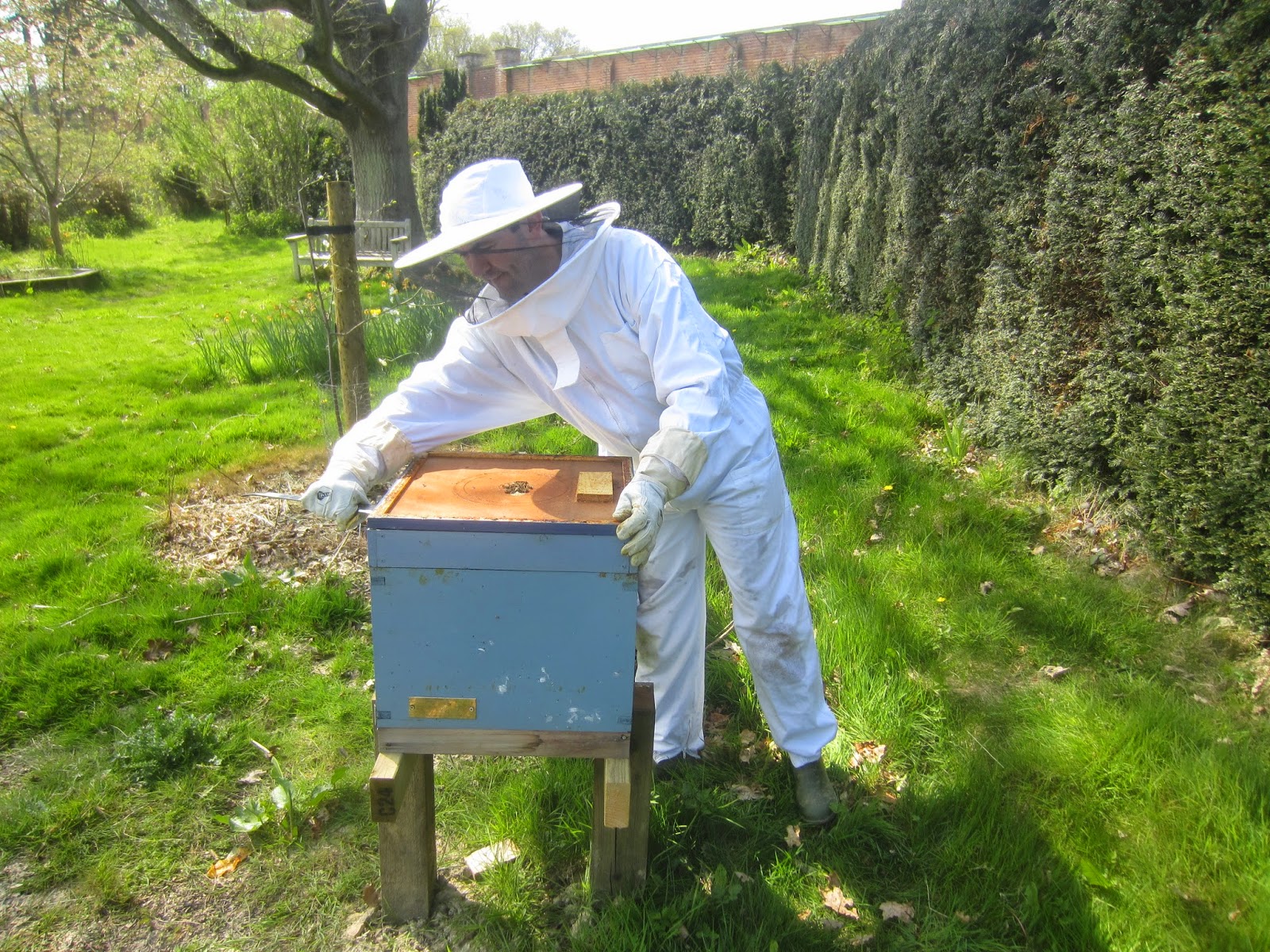
This operation required that both hives be open at the same time, as we would take a frame from the centre of the Star and put it into the centre of the Moon, exchanging it for a frame from the edge of the Moon, which would go to the edge of the Star. This required a fair amount of frame shifting. I was at the Star and Goulwenn at the Moon and we exchanged frames while the bees looked on bemused. They were less aggressive than previously and, though we were stung, it was not quite so bad and afterwards the sweet bees did not follow us quite so far.

One hive open - the other to follow!

Having selected a good frame from the Star, I brushed off the bees (using a newly-purchased bee brush) and hung it to one side for later use. Meanwhile Goulwenn opened up the Moon and took out a frame from the edge and handed it to me. I inserted it into the Star before closing it. Half the operation done! Goulwenn then made space for the egg frame in the middle of the Moon and we slotted it in. We closed the Moon with a prayer that the bees would get the message and rear a queen. We shall see next week.

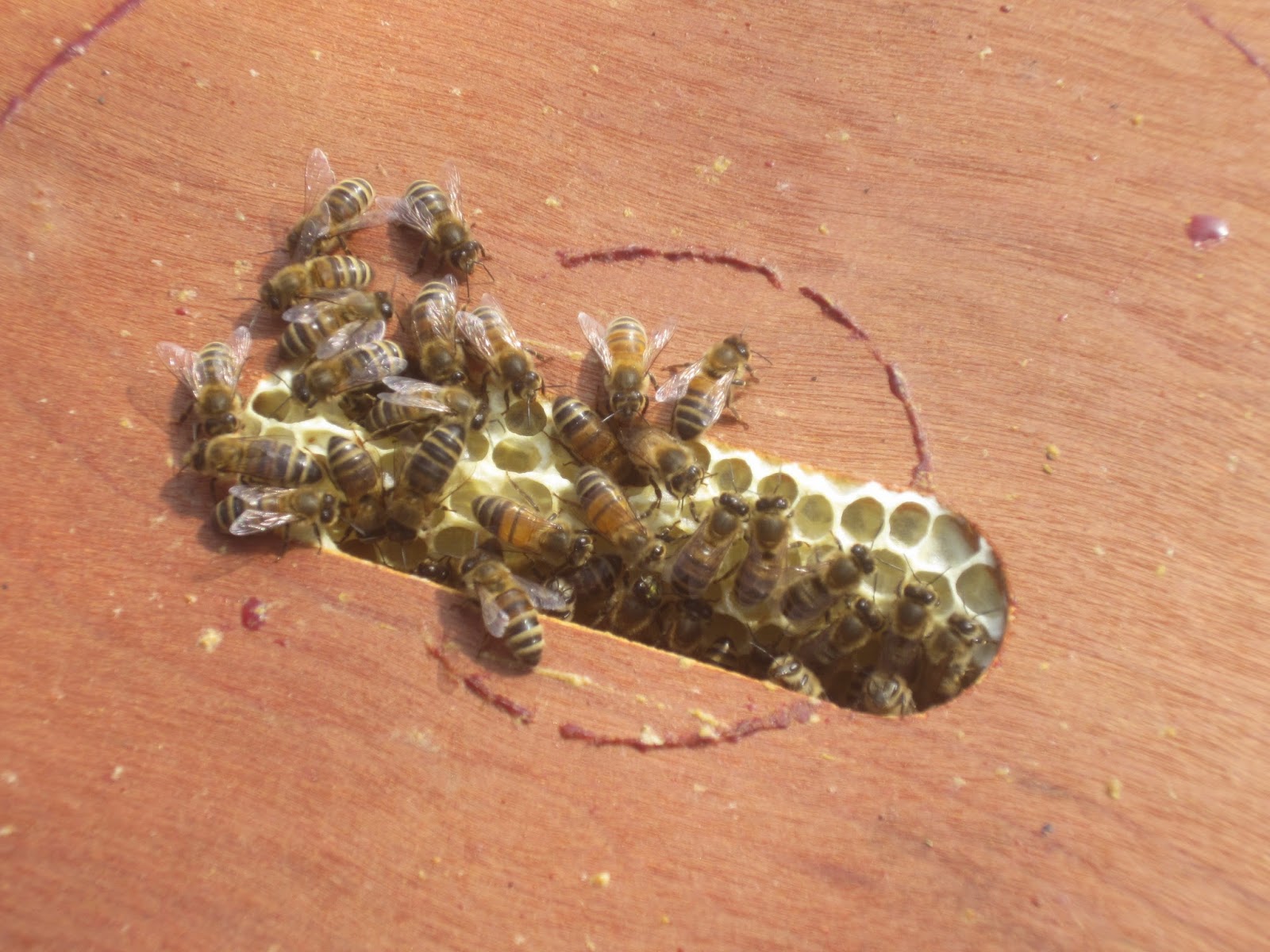
Finally, we had a look in the nuc. I decided to feed them, so they would draw out more comb, or have more of an energy boost, before their relocation at the weekend. The feeder I used is a contact feeder attached to a jar (it wasn't easy finding a jar that would fit the feeder, although it is sold as fitting most jars!). As this is quite high (and raises the roof substantially), I had to find other objects to hold the roof up. This is where toothbrush mugs and pen mugs came in handy.Plus they added a few interior decorating highlights to the hive, which the bees, all being female, surely appreciated!

The many uses of mugs
(the roof of the nuc goes over the mugs)

Monday, 8 June 2015

A hive is a castle

With some money to spare due to good honey and soap sales last year, I thought it would be good to add accessories to the hives (aka pimp them up). Among the items I purchased were castellated spacers. Now, having studied some history and also paid attention during several guided tours of castles, I knew the privilege to castellate a house was highly desirable in the middle-ages, because it basically meant you could add battlements to your house, making your home a castle. I wanted to do the same with the hives, though the battlements aren't really visible. In a hive you mainly add castellations to the inside of the supers to keep the frames evenly spaced (which is why they are actually called spacers). As I have had issues with sliding super frames in the past, I thought this was the perfect solution.
Regular readers will already know where this is leading - not all turns out as simple as it seems.
Although three supers are on the hives, there are still three empty ones I thought I could castellate. The problem was the spacers were longer than the inside of the super. So, using the kind of gentle persuasion only a hammer can give, I wedged the spacers into the side panels. This meant the spacers warped a bit, but I hope the nails will hold them in place until the bees propolize the spacers down for good.

Wedging battlements into the inside of a super
A super castle
Frames spaced in the castellations

Friday, 5 June 2015

Moon attacks!

Main focus of today's inspection was the Moon. Still, we checked up on the Star first, just to see whether all was fine.

Checking the honey collected in the super

First of all we leafed our way through the super, to check how much honey had been collected and whether any was ready to harvest. As the Star is essentially starting up, there was no frame that was fully capped, as was to be expected.

A pupil smoking - not normally allowed in schools!

A quick smoke and look into the brood box revealed the queen and that all is proceeding as it should in the Star. So, having satisfied ourselves that the Star at least was acting normally, we opened the Moon.

Capped comb with finished honey beneath.
If only all frames could be this way!
Here, we once again checked the supers first. The top super was not empty, but uncapped. The super below, which had been almost full last inspection, still defied the full house and too many frames had large uncapped portions for a harvest to be viable. At least, that's what I think. Maybe I'm wrong and, given it's rape, we should have spun out whatever's there. Time will tell.

The brood box was very interesting. Despite there not being a laying queen, the hive seemed very full and the colony strong. But, strangest of all, where there had been nothing the previous week, we were suddenly confronted by a mass of queen cells. What's more, the queen cells all had larvae in them. Where had these come from? A careful examination of the frames showed that there were no other eggs in the whole of the hive, only those in the queen cells. How can they be rearing queens? Well, the answer, in my opinion, is that some of the workers have started laying. Because they are unfertilized, they can only lay drone eggs. For some reason the Moon was fooling itself into thinking its workers could raise a queen from drone eggs, hence the queen cells. Sweet, but biologically impossible. But interesting to note that even bees indulge in wishful thinking.

Bees' castles in the air

Initially, not having thought the problem through properly, I thought I'd leave two queen cells and see what happens. But, on deeper reflection, I think the Moon should be given a queen as soon as possible. As the nuc queen is already accounted for, what I plan on doing is putting a frame from the Star with eggs on it into the Moon and then the Moon bees can raise a queen from one of those (they'll probably go for raising at least five, if not fifteen). That's something for the beginning of next week.
Meanwhile the Moon bees were starting to get distinctly aggressive. They were already having a bad day, what with them being queen-less and therefore doomed. Then we go and open their hive and snoop around. That can't have brightened their day and they started to show it in that inimitable way bees have.

Bees start their attack run

As quickly as possible we left the apiary, but the bees were properly upset and wanted us to know. In fact, they followed us for a good five hundred metres. And these are bees that generally are not followers!

Wednesday, 27 May 2015

Marking Queens

Last inspection we'd seen the nuc queen and knew there was a laying queen in the Star; the Moon was queenless. Purpose of the inspection today was to see whether the nuc queen had mated and if so, to mark her. I was also keen on marking the Star queen, if she wasn't the green queen from the Moon and to see how matters had developed in the Moon.

The hive entrances were all busy so the bees are all foraging and bringing back pollen and honey. We saw some enormous pollen sacs on some of the bees.

Bees bringing pollen to the nuc - before they were disturbed

Bees trying to get into the nuc after the inspection - quite a crowd!
Note the bright yellow pollen sacs.

We opened the nuc first and discovered to our delight that the queen here has started laying. There were quite a number of eggs. The bees have also started messing around with queen cups, so the nuc may be one to watch for a mini-swarm (not sure that nucs swarm, but better safe than sorry).

If you look carefully, you can see eggs - little white specks at the bottom centre of each cell.

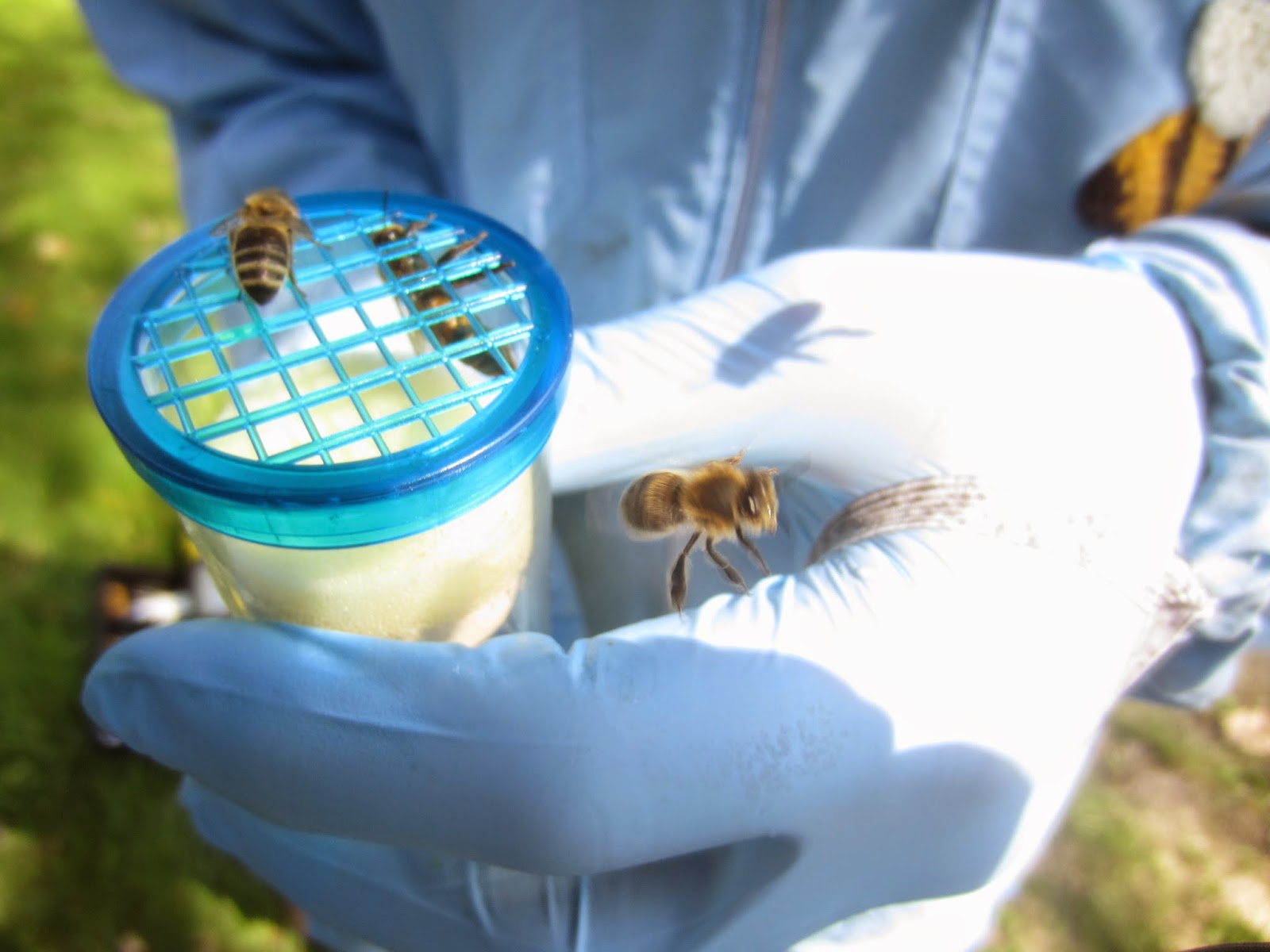
The queen - slim, brown and elegant - was spotted fairly quickly (after all, she only has three frames to hide on) and captured and put into the marking chamber, where she was dotted with a green dot. While queens should be marked a different colour for each year, I find this is not necessary for the two hives we have, as it is easy to keep track of them.

The queen, still free, about to disappear off the edge of the comb

The queen is inside the plastic chamber. This time some of the workers were splodged with paint, too.

The freshly marked queen
In the Star things looked much better than last time: gone was the awful smell and the colony has expanded well, moving centrally up: so in the brood chamber the central five frames are fully laid out and above them in the super the middle frames are also starting to fill up. As the hive is not that full yet, the bees have not expanded to occupy all the space yet. As to be expected in this circumstance, the bees have no thoughts of swarming.
But what did surprise us was that the Star has its own dark queen (well spotted, Goulwenn). So she must have hatched from the cell we put in two weeks ago and mated quickly to start laying. She was captured (with some difficulty) and processed like the nuc queen.

Trying to capture the queen

Dotting the thorax through the criss-cross marking cage

One newly marked Star queen


With two queens spotted and marked we were going for a hat trick.However, we did not see the queen in the Moon. The queen cell we had left from last time was empty, so the queen must have hatched. But she proved elusive. The colony is definitely queen-less, as we saw no eggs or larvae, but quite happily so. This means they are expecting a mated queen soon.
But looking back, I realize we had this same situation last spring: a sudden disappearance of the Moon queen with no evidence of swarming. What do the Moon bees do with their queen? Perhaps they are revolutionaries....
What ever their administrative preferences, one super is looking close to full now and we moved the not quite ready frames to the centre and the finished ones to the edges so that hopefully soon we'll have a full super to spin out. That will be mainly rape honey - delicious!

Friday, 15 May 2015

Queen Smells

After the confusion last week, I was hoping that this inspection would answer some of the questions concerning queen distribution that the last inspection had left open. With Mr. V and two pupils, we checked out all three hives.
The Moon once again posed a riddle. There was evidently no queen, as no larvae or eggs. The bees hadn't swarmed either, as they were everywhere in multitudes. However, we did find a cornucopia of queen cells, many of which were sealed. One frame had eight queen cells on one side!

Eight queen cells (the long dangly bits) on one side!

So the bees are obviously queenless and plan to raise a few, swarm with the first (and possible further ones as they hatch), and then stay with a subsequent queen, when they feel they've had enough of swarming. The fact that there is no queen in the Moon, suggests I moved her to the Star last time when I transferred the wild comb.
However, knowing the Moon is queenless meant I could stop them swarming in the near future, by removing all queen cells except one.

Apian regi- and infanticide!

As there are no more eggs, the bees cannot construct another queen cell. And until the new queen is hatched, mated and laying, there is no risk of a swarm. I think that's how it should work! The bees probably have other plans.
Looking in the super it is obvious a flow is on, as this was looking quite full of honey. To give the bees more space for honey and themselves (not that they have drawn out the brood frames exchanged for the ones I took out last time), we supered up. This might also tame their swarm tendencies a little.

The nuc was busy with bees. The queen here has hatched and looks lovely. She has not mated yet, which you can tell not only by there being no eggs in the nuc, but also by the fact she is still very slim.

The new nuc queen - check out her legs!

The Star was interesting, again. The first thing we noticed was a horrible smell that emanated from the eke and wild comb. Why exactly it had started to smell, I don't know, but it could be a mixture of lots of dead drones and some dysentery. That being as it was, we reluctantly decided to get rid of the wild comb. Pity, as I had been looking forward to harvesting wild honey from that.

Getting rid of the wild comb

A look into the brood box showed us that the Star has a queen that is laying (we saw eggs - many of them).

Larval proof there's a laying queen

I assume that means the green queen from the Moon is now in the Star as I find it hard to imagine the celled queen we put in last week would have mated already, especially as the nuc queen hasn't. My version of events is the green queen killed the new queen, possibly before hatching, as the colony is not strong enough to swarm. Indeed, it may be tight on stores, as the workers seem to have chased drones off; we saw many many dead drones.

Dead or near-dead drones

Anyway, at the end of the day it seems, the Star is fine with a laying queen (not that we saw her!), though the colony is not explosively strong (as is the Moon) and has yet to draw out the brood comb. Nevertheless, I might super up on Monday to catch the flow, if it is still on. The Moon is once again, like last year, somewhat inexplicably queen-less, but with one developing. The nuc has a queen that should mate soon. So, calm and happy days ahead, it seems. If only...!

Bees on the Moon

Star-stuck bees


Friday, 8 May 2015

Grass Plugs

Pulled the grass plugs out today. The bees seemed desperate to get out and generally the bees around the apiary were in high spirits and very busy.
Let's see what next week brings.

Thursday, 7 May 2015

Queen Cells

Having discovered last inspection that the Moon was showing swarming tendencies, I was prepared for taking swarm control measures during the inspection today. I had a nuc box prepared, as well as the empty Star, as I wanted to rear two new queens: one in the Moon (after having transferred the old Moon queen to the Star) and one in a nuc box, as last year. Of course, the bees decided to be different and thwart my plans.

The weather has been rotten lately, so I was not hugely surprised to see them flying around in force in the sunshine today. As soon as I opened the Moon and started checking, I realized though that not all was fine in the Moon. The bees had not swarmed yet - that was obvious: we were inundated in bees. However, in the brood box I counted no fewer than twelve viable queen cells, three of which were sealed. Usually the old queen flies off before the queen cells are sealed, so obviously the bad weather had kept her inside. The playcups I had ignored last time had obviously been turned into full queen cells, though I still don't understand how the bees could have moved so fast to have sealed queen cells in the space of 7 days. There must have been eggs in some, though I didn't see any. Will have to read up on that again.

Three queen cells on one side - two of which are sealed

So, saved from losing a swarm by the bad weather, Goulwenn and I examined all frames carefully, looking for the newly-marked queen. Nothing. We went through all frames twice, but failed to find her. How do you do swarm control without finding the queen? I know there is some complicated method, but I didn't want to try that. As the bees starve the queen before swarming, so she is fit to fly, I thought maybe she had crawled through the queen excluder and was hiding in the wild comb. Of course we have no chance of finding her in that. She is certainly not laying as much, which is also standard procedure before a swarm.

Try finding a queen in this!

In the end we did the following:
First of all we destroyed all queen cells except for two.

This would have become a queen

We put one queen cell into the Star, together with three frames of bees, one queen cell into the nuc box, together with a frame of food and another frame of bees, plus some more shaken off a frame. I turned all entrances different directions and put grass into the entrances, so the bees would stay inside their new home for a day, to get used to their new surroundings. I destroyed all queen cells in the Moon, as I assumed, though invisible, that the queen was still in there. Then, in a fit of spleen, I put the wild comb onto the Star, too. In some way I think that should help me to find out where the queen is. If she is in the wild comb (and now in the Star), then there are too few bees there to swarm and she should kill the new developing queen and the Moon will raise a new emergency queen. If she is in the Moon, then the Moon might swarm, but there aren't that many bees left there, so they might not swarm (or do so later). Somehow, I am almost resigned to losing a swarm this year, but as long as I have two viable colonies at the end, I think I'll be happy.
I'm sure the bees will do everything differently, though. They always seem to.

The set up at the end; Star with wild comb, nuc and Moon
Throughout the inspection the bees were well-behaved and fairly calm. I was only stung once. The air was full of them though and half-way through the inspection I heard shrieks and screams from behind the hedge. Unsure of who was there and with not a lot I could do, I listened to the cries with some amusement. Someone was not having a good time with all the airborne bees. A few minutes later we saw the school's mountain-biking club emerge and pedal at top speed away from the environs of the apiary. The teacher in charge later told me they had been beset by bees, though not many had stung, it seems.

Thursday, 30 April 2015

Bees revving up

The Moon looking like a multi-layered cake.
Having sorted out the hive ready for the new season last time, I wanted to check up on the bees, mainly to see what their thoughts on swarming were. Unfortunately, I had to do the inspection myself. Having grown used to Goulwenn's help and company, I must say it was a much less fun affair without him.
 
The bees are very busy and working in the super, but not many of them yet, so they definitely have enough space. The brood box was very busy, as last time, with only two to three frames not having brood on them. I did not see the queen this time, despite her mark, but many eggs, which show she is around and busy. As last time, there were a number of queen cups, but more the ones bees build for practice rather than ones which really have a queen in them. I did open one to check and make sure and there was, as expected, nothing in it. So the bees are merely warming up, but don't really want to swarm yet, which would make sense, as they have just had an increase in space. However, towards the end of the inspection, I saw a queen cell that looked serious and - sure enough - on examining it, I found a larva inside! I took her out, giving me time till next week, if the bees are serious about swarming. The number of drones in the hive suggest they are, so we'll see what next week brings.

Although I did look diligently I now hope I didn't miss any other queen cells. Time will tell!

While closing the Moon up again, I took a look at the wild comb. The bees have been busy repairing this and developing it and it now covers most of the eke. That should be lovely wild comb honey.

The wild comb with its bee architects


Monday, 20 April 2015

Bees gone wild!

As we've had a few fair days, I thought it was time for the first full hive inspection, with the express intent of also finding the queen (before the hive population explodes), so we can mark her. As always, I was ably assisted by Goulwenn. In fact, this time I let him do the hive inspection himself and I was the onlooker and (much crummier) photographer.

As soon as we opened the roof, we knew we were in trouble when we saw comb almost blocking the hole in the crown board (the hive's ceiling, so to speak).
This is not good news!

Goulwenn had great difficulties lifting the crown board off and it soon became clear why.
Goulwenn has reached his ceiling!
The reason - wild comb


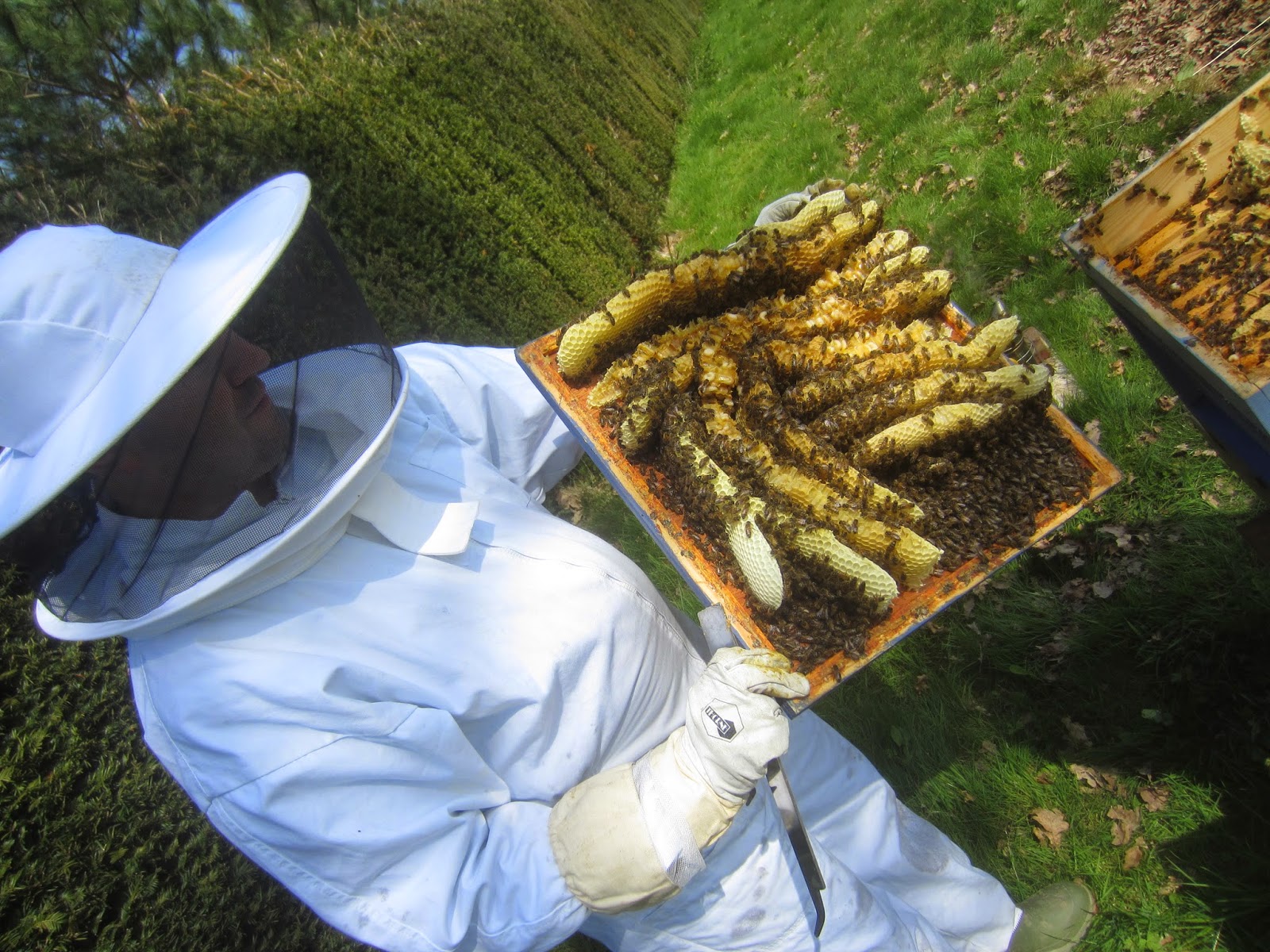
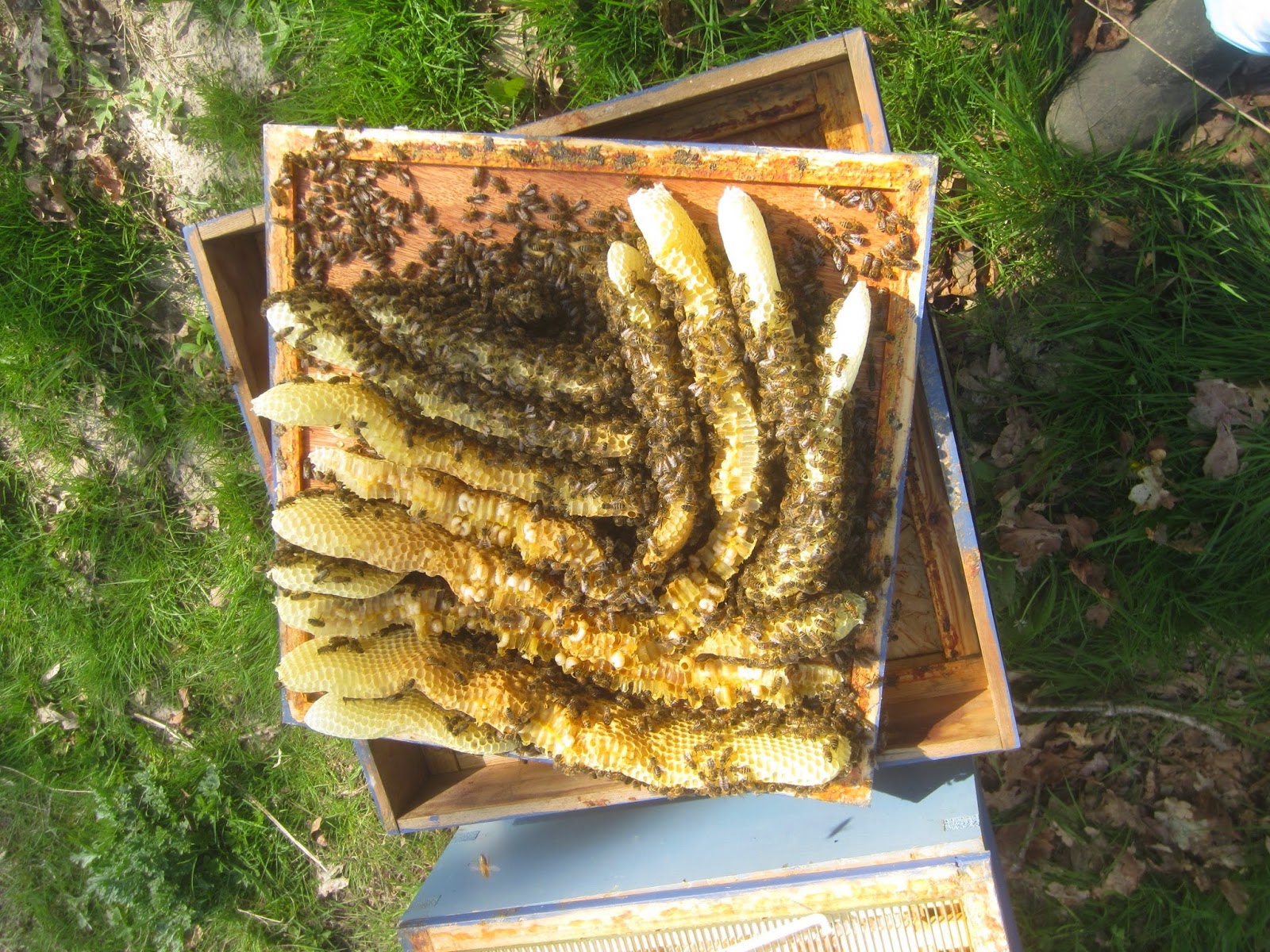
The bees were obviously more active than I thought - and certainly not as lazy as I had been. Although temperatures had not been really inviting, the bees, safe in their Celotexed home, had decided differently and started redecorating the hive. The eke, which is always left on the brood box over winter in case feeding becomes necessary, had been filled by the bees with wild comb. Unfortunately, by lifting the lid, we did destroy some of the comb, with brood in it - but what an awesome sight! This is how bees fill a 40x40cm cavity!

Bees gone wild! This is what wild comb looks like.

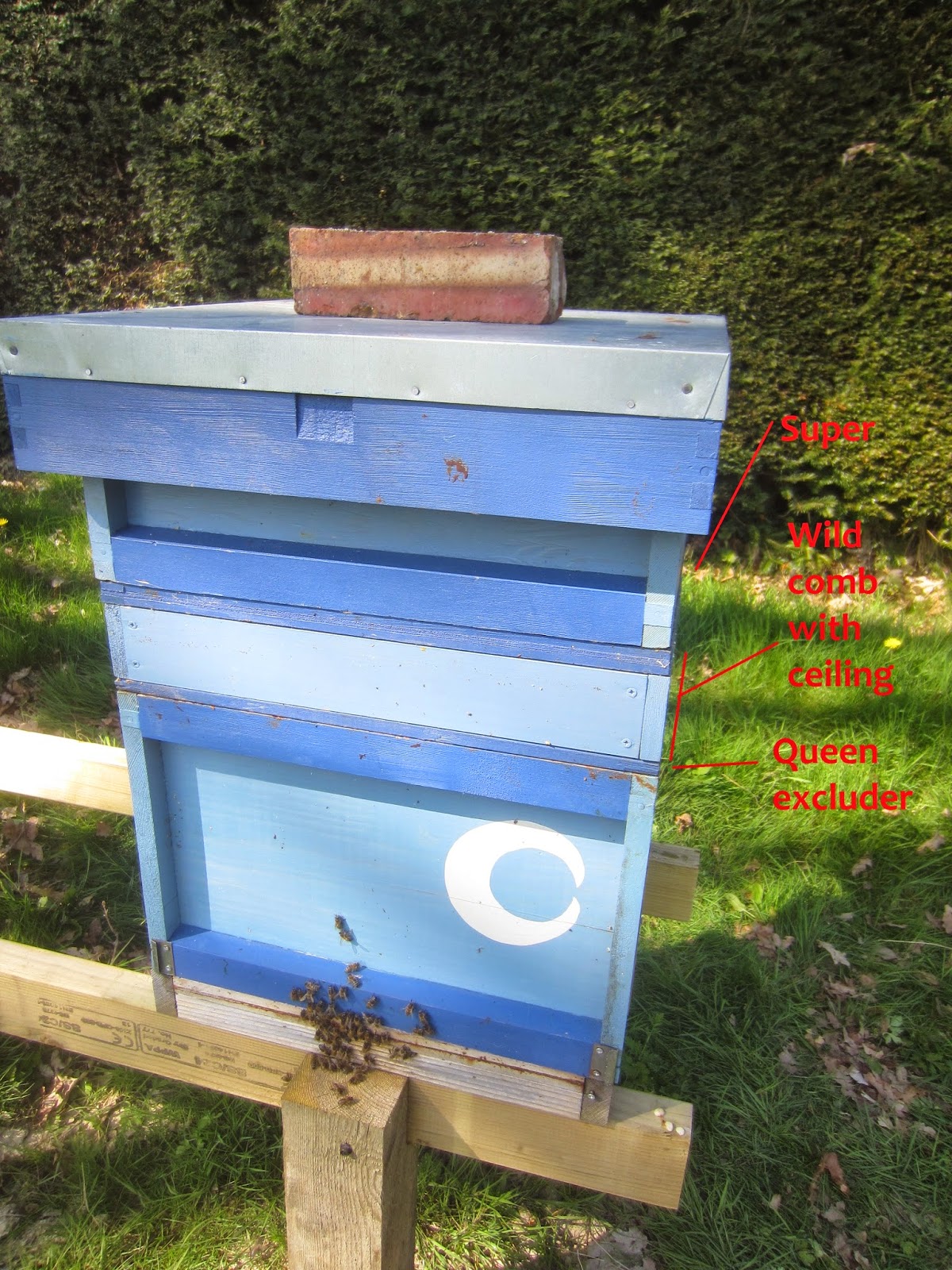
Having discovered that, we were then somewhat at loss what to do with the wild comb. We decided to keep it (would be so unfair to destroy it; would also kill too many larvae), but make sure the queen could not lay in it. So, when we reassembled the hive, we put a queen excluder on the main brood box, so the queen will stay in the brood box (we knew she was in there - of that anon), and the wild comb on top of that. When the larvae hatch from the wild comb, which the bees will probably extend further (once you've started a DIY job, why stop in the middle, right?), no new ones will be laid there, so the bees will probably fill the comb with honey. Wild comb honey! Looking forward to that. Anyway, this is what the final set-up then looked like.

How we put the hive back together again

Goulwenn searching for what is so hard to find
Before we put it all back together like that, we had to find the queen. Never an easy task. I think the last time I saw the Moon queen was some time in 2013. Of course, it was a different queen then.

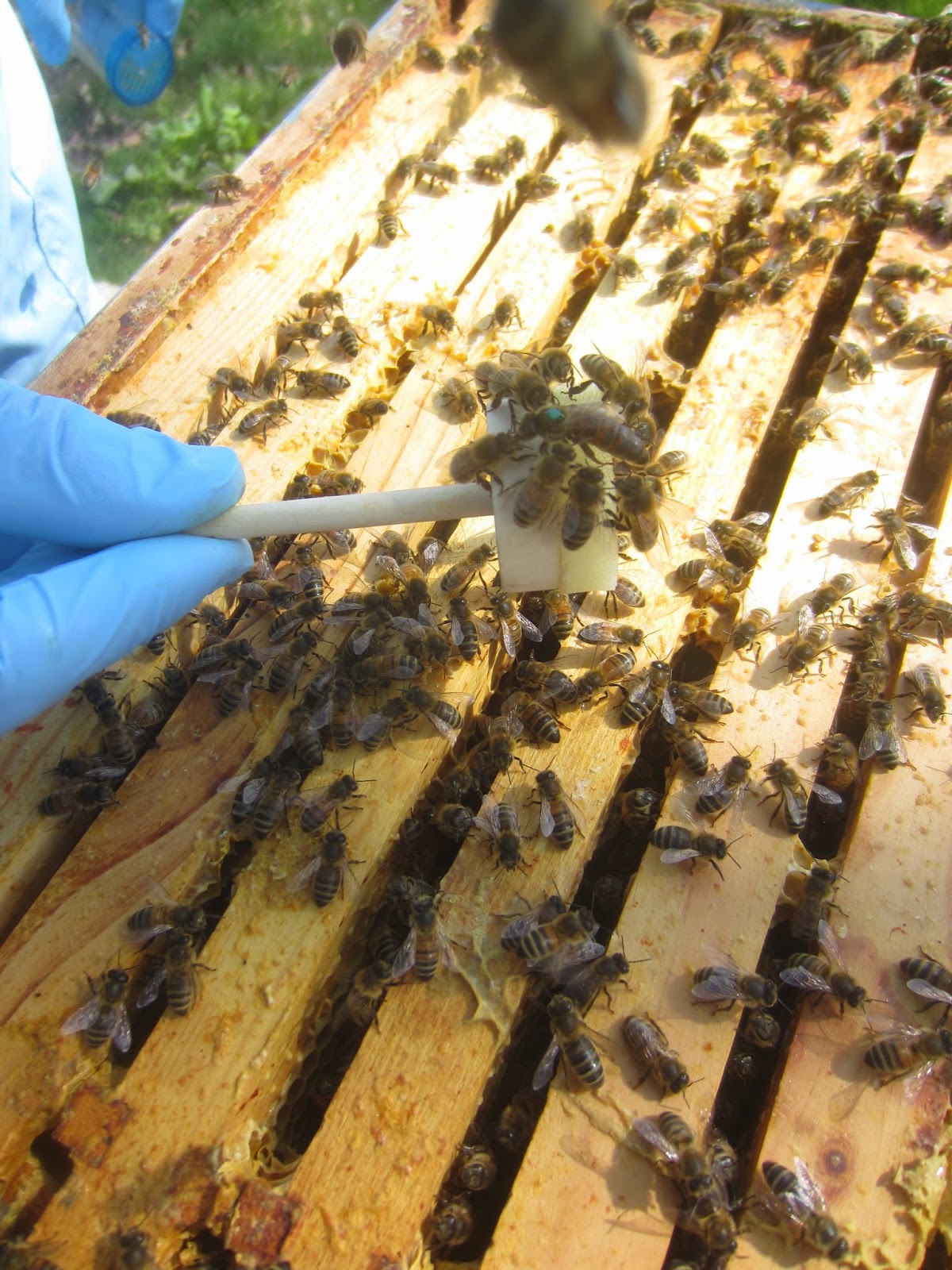
Goulwenn went through the frames once and we both looked - nothing. We decided to go through them again and - amazingly - we saw the queen, scuttling around where we least expected her. She let herself be trapped quite easily and then I put her in the marking cage. While I held her carefully pressed against the mesh, Goulwenn painted a little green spot on her abdomen. All done!
After the marking ceremony, she was reluctant to leave the pad and a court of her bees immediately gathered round. Eventually, she slipped off the pad and disappeared into the hive.
We put a super on the hive, so the bees would have enough space, and then closed all up. A successful, if somewhat unexpected, first inspection.

The queen in the marking cell

One marked queen, with attendants

The newly marked queen holds court - on a pad

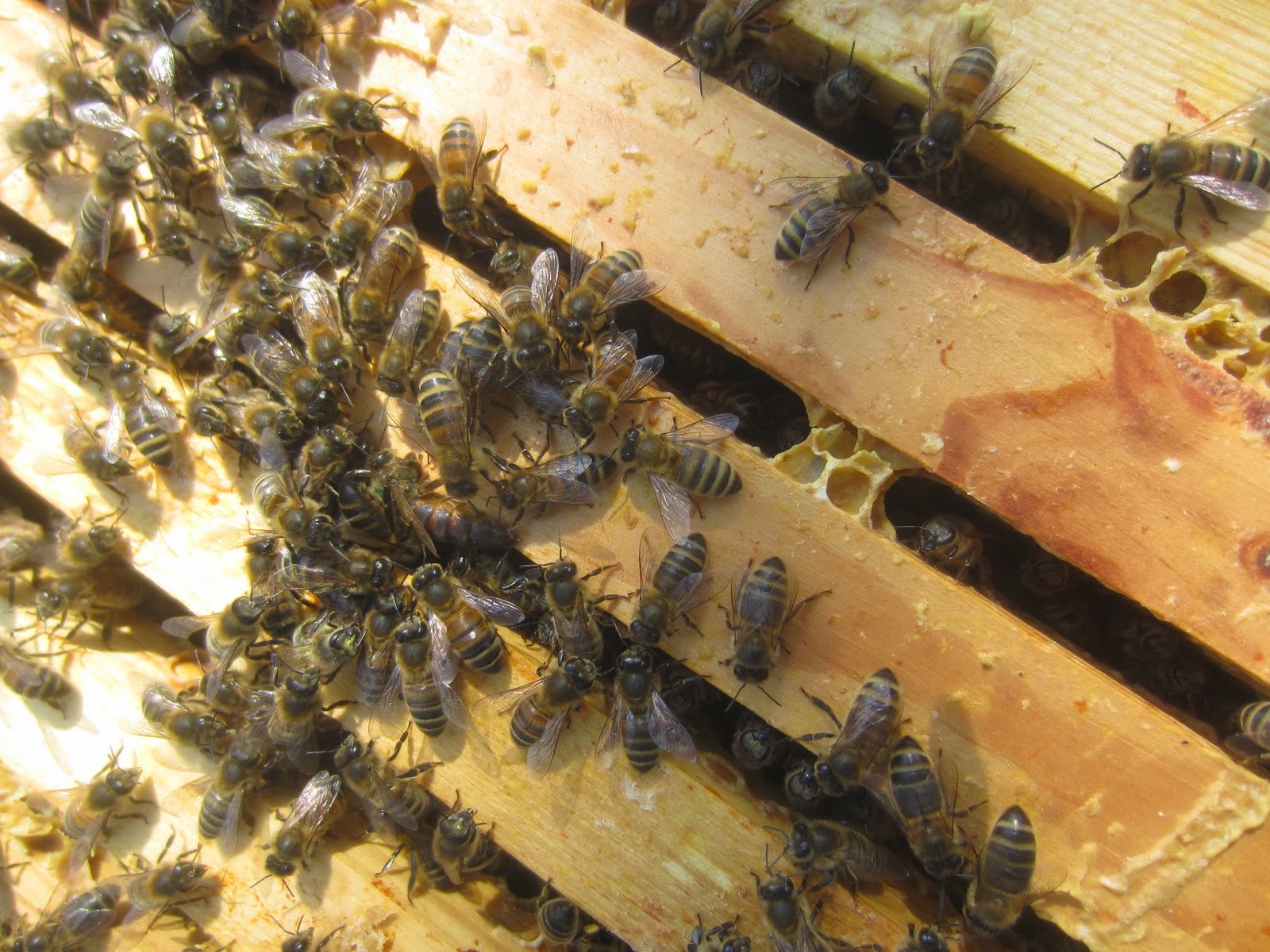
Queen disappearing down a seam. Can you spot her abdomen?


Friday, 17 April 2015

Maintenance and Repair

The Moon busy again
It's been a quiet winter, so not posted for a while. However, I have been doing little things, but none of them worth posting as yet (there is a larger project in the pipeline, but it's not ready to be unveiled yet).

As the weather is improving now, I decided I need to attend to a number of issues urgently.
First of all I removed the Celotex from the Moon. The bees are out in strong numbers and I think they should no longer need the extra protection. It still gets cold at night, but there is enough forage available for them to eat their way through that, I think. Also removed the mouseguard, so the hive is once again working as usually. As it was windy, I didn't open the Moon up, but intend to on Monday, not least because I have to mark the queen.
Various hive bits in the process of being de-propolized


Second task was to go through all the supers and frames and clean them a bit. I scraped off the remains of the dead bees, wax and - mainly - propolis. It was harder work than I thought, but the hive tool is great (love the hive tool!) and after a few hours all wooden surfaces were tolerably smooth again. At some point I think I should burn the wood slightly (I think that's what they say you should do). Will try that next year.

Finally, I had some repairs to do on the Star brood box and roof. Due it having fallen over, the roof was broken and the brood box slightly damaged, too. Fixed both of those best I could. The equipment is now as ready as it will ever be. Roll on the good weather!
Fixing the Star


Thursday, 15 January 2015

Acid treatment

A bottle of acid
With the weather getting shiveringly cold, it's time for the acid treatment. This year I thought I'd buy the acid in bulk, so I'd have enough to last a few years. So, thank ebay, I had a largish bottle of oxalic acid, which aroused quite a bit of interest from the pupils. However, I have since discovered that the acid does not keep, as the sugar, with which it is diluted, somehow ferments (or similar - can't quite remember what), so will not be good for more than a year or so. Great! So much for wanting to do it all myself.

Be that as it may, I had three keen volunteers, all from younger years so the beesuits trailed on the ground somewhat. Not sure the mud will go out (stains generally never go out in the wash), but it's time to wash the suits anyway.
First excitement of the day was that the hive stand has been completed. So Mr. V and I decided to heave the hive onto the new stand after the acid treatment. No point in getting the bees riled up because their house is moving to then open them up!

The new, sturdy stand - thanks to Chris the carpenter

Opening the hive somewhat more noisily than I wanted to (yes, the bees had stuck everything down properly with propolis), we saw numerous bees inside. They had built some brace comb over the top and seemed to be occupying five seams, which is quite a lot. The store situation looked good. Quite a few bees buzzed around us, but there was no hint of aggression in their buzz, more curiosity. They landed on the pupils, Mr. V, me and the syringe. None stung.

Bees watching the acid drip in

As quickly and thoroughly as possible I dripped the acid into the seams. Although the advice says to move the frames apart a little before doing this, this would have been impossible, as all frames are firmly stuck down. Had I tried, I'm sure the dummy board would have come apart; it has made several attempts to do this in the past and then we would have been nowhere.
After finishing with the acid, we quickly closed up the hive and then lifted it onto the new stand.

The hive on its new stand
Checking the mouse guard, with pupils looking on