Tuesday, 30 June 2015

Queening gone mad

After the inspection today I felt I had gone mad or through the looking glass into some weird game of chess, where hives are constantly being re-queened. I really don't know what the bees are up to anymore (I feel like an absolute amateur again), but they are definitely not sane.
First, I looked into the Moon. The queen there has hatched - I saw the empty cell - but is not laying yet. I didn't see her during my inspection, which was fairly thorough. There aren't many drones (where would they come from?) and not all frames in the brood box have been drawn out yet, though one super is fairly heavy with honey. The bees were faintly aggressive again (I was stung four times). So for the Moon, it's sit and wait again, though somehow I'm not confident the queen will be a success.
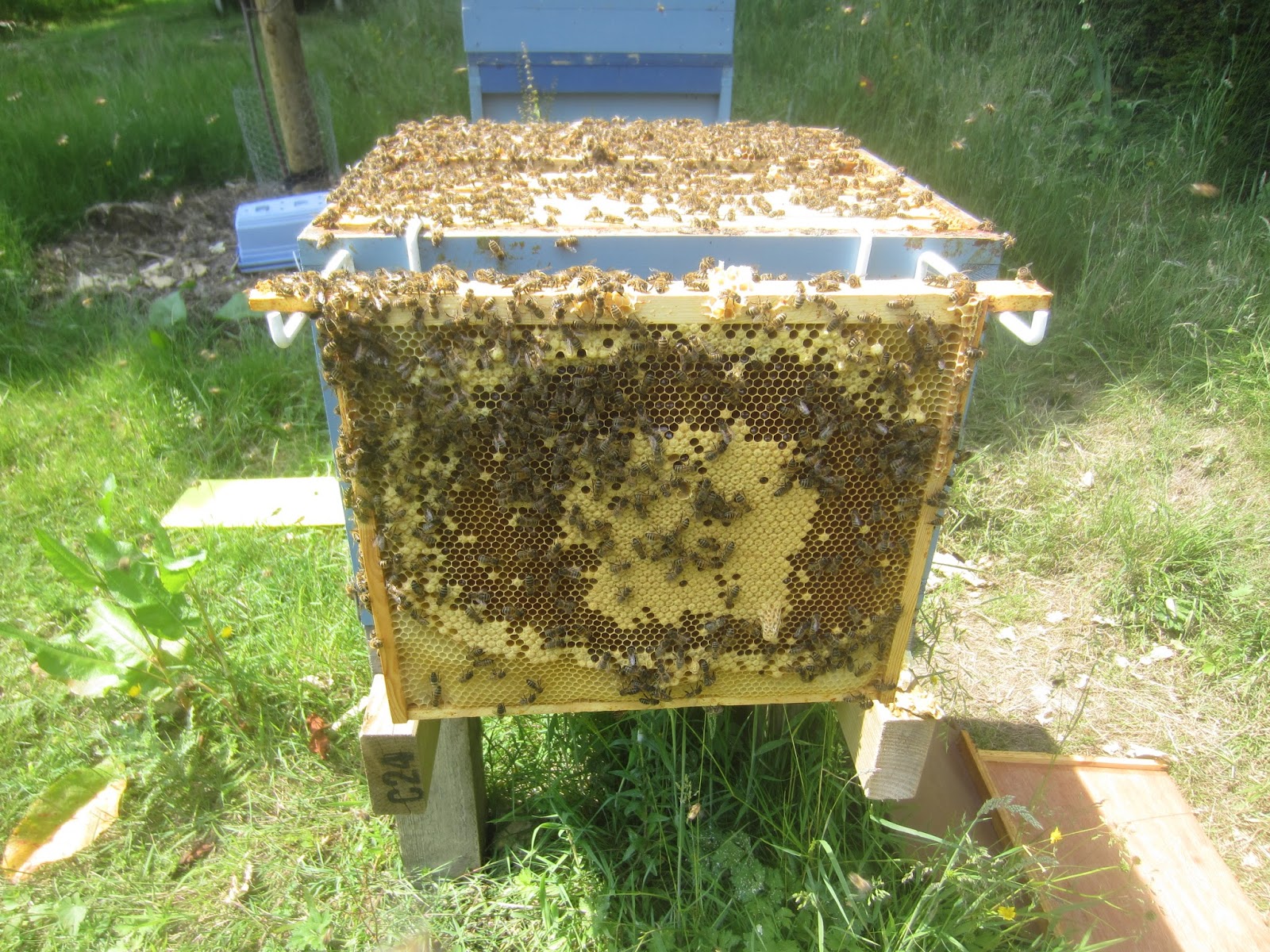
The Star was an entirely different story. If you remember, here we had a dark queen laying well last time I looked and I had decided to feed them up, so they would draw out more comb in the brood box. Well, imagine my dismay when the edge frames were as flat and clear as before and most of the honey was stored in what used to be brood frames. What had happened here? I saw a number of queen cells and thought the bees must be getting ready to swarm. Silly me. I started removing the queen cells and as luck would have it (I must have a generous guardian bee watching over me), from one of the ones I had removed very carefully a queen emerged. I was gobsmacked, to say the least. I quickly caught her in the queen tube and put her to one side, not sure what the rest of the inspection would bring. I removed about five other queen cells, one of which had a queen almost ready to hatch, but still pale. As I went through frame after frame, it became clear that the Star had no queen any more. Where has she gone? Having done no inspection since I saw her last and today, I couldn't have squashed her. The bees have not swarmed, as numbers, I felt, were pretty much the same as last time.

Removed queen cells - one with an almost 'finished' queen

Anyway, I marked the queen, who is as yet unmated, and released her into the hive. My heart missed a beat when on landing on a brood frame a bee went up to her and looked like she was going to sting her! That would have been the last thing I needed. Luckily, the queen was not stung as I saw her later. She will hopefully mate and then all will be fine with the Star again.
Nevertheless, I am at a complete loss. Why are both colonies getting through their queens so quickly? Queens don't leave the hive (unless they want to swarm) - so what happened? I will have to do a lot of reading up over the summer to try and solve this mystery. In the meantime, I hope the bees sort themselves out, so we can return to some semblance of normality.

Wednesday, 17 June 2015

Moon queening

With the Star sorted as best I can, attention must now turn to the Moon and what's happening there. Last week, if you remember, I had given them eggs and expected them to rear a dozen queens or so from that.
But before I get to that, I managed to solve a somewhat sad mystery. Last inspection with Goulwenn the smoke from the smoker had suddenly started to smell rank - like long decayed beasties in the sunlight. The lovely thing is this stench has caught in my veil, so I smell it each time I put on the beesuit. Ugh! While preparing the smoker for today's Moon inspection, I saw what must be the cause for that awful smell.

The bees' own Pompeii


I don't think she's solely responsible (I probably emptied the others), but a few of these burnt alive can't smell good.

Having sorted out smoker issues, I opened up the Moon. Little had changed in the supers and there were very few frames completely sealed on both sides. The bees were very flighty and came out in strong numbers to see what the big blue thing was doing to their house. However, none stung and they seemed more curious than aggressive. I was surprised that there were still so many bees, as they have not had new brood for a few weeks now. As I had marked the frame with the eggs on it that I had put in, I did not have to look at all frames, but just work my way gently to that one.
I expected to see similar queen cell scapes that I had seen last time, but the bees seem to be more intelligent. They must know that raising more than one queen is of no use. Anyway, there was only one beautiful queen cell and a few messy attempts at something halfway between drone cell and queen cell. I removed these, just to be sure, and left only the one cell.

The queen cell, at the SE of the central brood patch.


If all goes well, a queen will hatch from that within the coming week. Should the weather hold, she will go on her mating flight and then return to the hive to start laying and rescue the colony from oblivion. Fingers crossed that this time nothing happens to the queen.
That all is not lost and miracles still can happen was proven by the fact that after the inspection the smoker was still burning and exhaling smoke as if it had only just been lit. Perhaps I am the better boy scout after all...!

Still smoking

Tuesday, 16 June 2015

Feed the Star

Housing the new queen with her nascent colony with friends made me think about the Star. Although this was a starting colony too, in many ways similar to the one I had transferred at the weekend, I had not fed it up, but put a super on instead, because somehow I was scared the bees might swarm. If I am to have a strong colony by the end of the season, I realized I must feed the Star. So at the weekend I made some syrup and on Monday I put Porter bee exits on the crown board (placed below the super), so that bees could exit the super, but nor enter it again. This meant the super would be isolated from the hive and bee-free.
Today I filled a feeder and placed it on the crown board, over the central hole. With ekes I gave it enough space so the super would fit on top.

A feeder full of syrup


While messing around with the super, I decided to change it with one of the new castellated ones. I can then castellate the other super and so slowly work my way through them all.

The super, now with spacer

The frames in the super have the beginnings of honey, but very few sealed cells. Hope nothing happens to them, while they are bee-less.

Saturday, 13 June 2015

A royal outing

Today was one of the most exciting days of my beekeeping life and I came another small, but important step towards feeling like a real beekeeper and not just someone who messes around with bees and does the best he can while trying not to upset the bees too much.
The queen I have been rearing in the nuc (and feeding every day this week in readiness for her touch down in a new environment) was delivered to friends today and put (together with her whole court of about 1000 bees) into a beautiful, new WBC hive.
It started yesterday evening: after a short, sharp shower and approaching dusk, I sealed the entrance to the nuc. In the afternoon, I drove to the school and prepared all my gear. As I was slightly nervous, I had a list to make sure I wouldn't forget anything. After all the gear was together, I removed the feeder and the mugs and tied up the nuc so that the roof would stay on and the entrance wouldn't fall out. Imagine how much fun that would be if the entrance block came loose while driving!

The nuc trussed up, ready for transport

A few bees from the nuc escaped when I took the feeder off, so I had three or four bees following me with an unhealthy interest as I carried the nuc box to the car, which I had parked close to the apiary site. The girls became quite insistent, so I drove the car away a bit, before securing the nuc properly with further straps.

All ready for transport

At a steady 38 mph I drove the bees very carefully to their new home. There the hive was waiting for them. Before unloading the nuc, I checked the hive components and made sure everything we needed was there. Of course it was - just my nerves had to make sure. As they had just had a harrowing 25 minutes or so, being rattled about on the best of England's country lanes, I let the nuc box rest a while by the new hive.

The nuc box, still sealed, next to the bees' new home (opened)
Then it was down to business. We opened the nuc box and transferred the bees frame by frame into the new hive.


One frame in the new hive

Inspecting the third frame before it is transferred

In goes the queen.

Lots of brood on the fourth frame
 
The final frame is slotted in

Checking all is ok.

After all the frames had been transferred to the new home, I used the bee brush to swipe any bees that clung to the walls of the nuc into their new home. Then we put the crown board onto the brood box and a feeder onto that. I say feeder, but it was more like a swimming pool. The bees obviously shared my views, as several went for a swim in the syrup and we had to rescue quite a number of them. One rescued bee decided to stay on my hand until she had thoroughly cleaned herself, making it hard to fill the feeders.

Filling a sugary swimming pool


With the feeder as full as the syrup I had brought along allowed (not even half-full!), we closed up the hive and let the bees sort themselves out. It took them a while to find the proper entrance to the hive, but within ten minutes or so, they had made themselves at home and were busy flying orientation flights in the drowsy afternoon sun.
What a great way to spend a few hours! I am completely chuffed that all went so well and that my friends now have a hive of their own with a queen reared by me from hives made possible by their generosity. Full circle!

The colony in the new hive. WBCs are beautiful!

Tuesday, 9 June 2015

Sending eggs to the Moon

This is not some late Easter joke about the rabbit in the moon and what it does for Easter, but actually what we did today. As Goulwenn and I had our hands full with re-booting the Moon (so to speak), there aren't many photos. Here's why:
Having thought about the plight of the Moon over the weekend, it became clear to me that it did not have a queen, that the workers were starting to lay drones and that waiting any longer with re-queening them would not help anyone, least of all the bees. They might believe they are rearing new queens, but the fact that the hive was devoid of eggs except in the queen cells suggests there is no queen and these are merely misguided workers indulging in wishful thinking. Besides, the bees were getting decidedly aggressive, which was doing their reputation as honey sweet girls no good.
So, how to give them a queen? As bees can raise a queen from any egg, the solution is simple: you give them a frame with larvae and eggs on it from another hive. As the Star had been formed from the Moon, the Star now was to give back to the Moon.
This operation required that both hives be open at the same time, as we would take a frame from the centre of the Star and put it into the centre of the Moon, exchanging it for a frame from the edge of the Moon, which would go to the edge of the Star. This required a fair amount of frame shifting. I was at the Star and Goulwenn at the Moon and we exchanged frames while the bees looked on bemused. They were less aggressive than previously and, though we were stung, it was not quite so bad and afterwards the sweet bees did not follow us quite so far.

One hive open - the other to follow!

Having selected a good frame from the Star, I brushed off the bees (using a newly-purchased bee brush) and hung it to one side for later use. Meanwhile Goulwenn opened up the Moon and took out a frame from the edge and handed it to me. I inserted it into the Star before closing it. Half the operation done! Goulwenn then made space for the egg frame in the middle of the Moon and we slotted it in. We closed the Moon with a prayer that the bees would get the message and rear a queen. We shall see next week.

Finally, we had a look in the nuc. I decided to feed them, so they would draw out more comb, or have more of an energy boost, before their relocation at the weekend. The feeder I used is a contact feeder attached to a jar (it wasn't easy finding a jar that would fit the feeder, although it is sold as fitting most jars!). As this is quite high (and raises the roof substantially), I had to find other objects to hold the roof up. This is where toothbrush mugs and pen mugs came in handy.Plus they added a few interior decorating highlights to the hive, which the bees, all being female, surely appreciated!

The many uses of mugs
(the roof of the nuc goes over the mugs)

Monday, 8 June 2015

A hive is a castle

With some money to spare due to good honey and soap sales last year, I thought it would be good to add accessories to the hives (aka pimp them up). Among the items I purchased were castellated spacers. Now, having studied some history and also paid attention during several guided tours of castles, I knew the privilege to castellate a house was highly desirable in the middle-ages, because it basically meant you could add battlements to your house, making your home a castle. I wanted to do the same with the hives, though the battlements aren't really visible. In a hive you mainly add castellations to the inside of the supers to keep the frames evenly spaced (which is why they are actually called spacers). As I have had issues with sliding super frames in the past, I thought this was the perfect solution.
Regular readers will already know where this is leading - not all turns out as simple as it seems.
Although three supers are on the hives, there are still three empty ones I thought I could castellate. The problem was the spacers were longer than the inside of the super. So, using the kind of gentle persuasion only a hammer can give, I wedged the spacers into the side panels. This meant the spacers warped a bit, but I hope the nails will hold them in place until the bees propolize the spacers down for good.

Wedging battlements into the inside of a super
A super castle
Frames spaced in the castellations

Friday, 5 June 2015

Moon attacks!

Main focus of today's inspection was the Moon. Still, we checked up on the Star first, just to see whether all was fine.

Checking the honey collected in the super

First of all we leafed our way through the super, to check how much honey had been collected and whether any was ready to harvest. As the Star is essentially starting up, there was no frame that was fully capped, as was to be expected.

A pupil smoking - not normally allowed in schools!

A quick smoke and look into the brood box revealed the queen and that all is proceeding as it should in the Star. So, having satisfied ourselves that the Star at least was acting normally, we opened the Moon.

Capped comb with finished honey beneath.
If only all frames could be this way!
Here, we once again checked the supers first. The top super was not empty, but uncapped. The super below, which had been almost full last inspection, still defied the full house and too many frames had large uncapped portions for a harvest to be viable. At least, that's what I think. Maybe I'm wrong and, given it's rape, we should have spun out whatever's there. Time will tell.

The brood box was very interesting. Despite there not being a laying queen, the hive seemed very full and the colony strong. But, strangest of all, where there had been nothing the previous week, we were suddenly confronted by a mass of queen cells. What's more, the queen cells all had larvae in them. Where had these come from? A careful examination of the frames showed that there were no other eggs in the whole of the hive, only those in the queen cells. How can they be rearing queens? Well, the answer, in my opinion, is that some of the workers have started laying. Because they are unfertilized, they can only lay drone eggs. For some reason the Moon was fooling itself into thinking its workers could raise a queen from drone eggs, hence the queen cells. Sweet, but biologically impossible. But interesting to note that even bees indulge in wishful thinking.

Bees' castles in the air

Initially, not having thought the problem through properly, I thought I'd leave two queen cells and see what happens. But, on deeper reflection, I think the Moon should be given a queen as soon as possible. As the nuc queen is already accounted for, what I plan on doing is putting a frame from the Star with eggs on it into the Moon and then the Moon bees can raise a queen from one of those (they'll probably go for raising at least five, if not fifteen). That's something for the beginning of next week.
Meanwhile the Moon bees were starting to get distinctly aggressive. They were already having a bad day, what with them being queen-less and therefore doomed. Then we go and open their hive and snoop around. That can't have brightened their day and they started to show it in that inimitable way bees have.

Bees start their attack run

As quickly as possible we left the apiary, but the bees were properly upset and wanted us to know. In fact, they followed us for a good five hundred metres. And these are bees that generally are not followers!

Wednesday, 27 May 2015

Marking Queens

Last inspection we'd seen the nuc queen and knew there was a laying queen in the Star; the Moon was queenless. Purpose of the inspection today was to see whether the nuc queen had mated and if so, to mark her. I was also keen on marking the Star queen, if she wasn't the green queen from the Moon and to see how matters had developed in the Moon.

The hive entrances were all busy so the bees are all foraging and bringing back pollen and honey. We saw some enormous pollen sacs on some of the bees.

Bees bringing pollen to the nuc - before they were disturbed

Bees trying to get into the nuc after the inspection - quite a crowd!
Note the bright yellow pollen sacs.

We opened the nuc first and discovered to our delight that the queen here has started laying. There were quite a number of eggs. The bees have also started messing around with queen cups, so the nuc may be one to watch for a mini-swarm (not sure that nucs swarm, but better safe than sorry).

If you look carefully, you can see eggs - little white specks at the bottom centre of each cell.

The queen - slim, brown and elegant - was spotted fairly quickly (after all, she only has three frames to hide on) and captured and put into the marking chamber, where she was dotted with a green dot. While queens should be marked a different colour for each year, I find this is not necessary for the two hives we have, as it is easy to keep track of them.

The queen, still free, about to disappear off the edge of the comb

The queen is inside the plastic chamber. This time some of the workers were splodged with paint, too.

The freshly marked queen
In the Star things looked much better than last time: gone was the awful smell and the colony has expanded well, moving centrally up: so in the brood chamber the central five frames are fully laid out and above them in the super the middle frames are also starting to fill up. As the hive is not that full yet, the bees have not expanded to occupy all the space yet. As to be expected in this circumstance, the bees have no thoughts of swarming.
But what did surprise us was that the Star has its own dark queen (well spotted, Goulwenn). So she must have hatched from the cell we put in two weeks ago and mated quickly to start laying. She was captured (with some difficulty) and processed like the nuc queen.

Trying to capture the queen

Dotting the thorax through the criss-cross marking cage

One newly marked Star queen


With two queens spotted and marked we were going for a hat trick.However, we did not see the queen in the Moon. The queen cell we had left from last time was empty, so the queen must have hatched. But she proved elusive. The colony is definitely queen-less, as we saw no eggs or larvae, but quite happily so. This means they are expecting a mated queen soon.
But looking back, I realize we had this same situation last spring: a sudden disappearance of the Moon queen with no evidence of swarming. What do the Moon bees do with their queen? Perhaps they are revolutionaries....
What ever their administrative preferences, one super is looking close to full now and we moved the not quite ready frames to the centre and the finished ones to the edges so that hopefully soon we'll have a full super to spin out. That will be mainly rape honey - delicious!

Friday, 15 May 2015

Queen Smells

After the confusion last week, I was hoping that this inspection would answer some of the questions concerning queen distribution that the last inspection had left open. With Mr. V and two pupils, we checked out all three hives.
The Moon once again posed a riddle. There was evidently no queen, as no larvae or eggs. The bees hadn't swarmed either, as they were everywhere in multitudes. However, we did find a cornucopia of queen cells, many of which were sealed. One frame had eight queen cells on one side!

Eight queen cells (the long dangly bits) on one side!

So the bees are obviously queenless and plan to raise a few, swarm with the first (and possible further ones as they hatch), and then stay with a subsequent queen, when they feel they've had enough of swarming. The fact that there is no queen in the Moon, suggests I moved her to the Star last time when I transferred the wild comb.
However, knowing the Moon is queenless meant I could stop them swarming in the near future, by removing all queen cells except one.

Apian regi- and infanticide!

As there are no more eggs, the bees cannot construct another queen cell. And until the new queen is hatched, mated and laying, there is no risk of a swarm. I think that's how it should work! The bees probably have other plans.
Looking in the super it is obvious a flow is on, as this was looking quite full of honey. To give the bees more space for honey and themselves (not that they have drawn out the brood frames exchanged for the ones I took out last time), we supered up. This might also tame their swarm tendencies a little.

The nuc was busy with bees. The queen here has hatched and looks lovely. She has not mated yet, which you can tell not only by there being no eggs in the nuc, but also by the fact she is still very slim.

The new nuc queen - check out her legs!

The Star was interesting, again. The first thing we noticed was a horrible smell that emanated from the eke and wild comb. Why exactly it had started to smell, I don't know, but it could be a mixture of lots of dead drones and some dysentery. That being as it was, we reluctantly decided to get rid of the wild comb. Pity, as I had been looking forward to harvesting wild honey from that.

Getting rid of the wild comb

A look into the brood box showed us that the Star has a queen that is laying (we saw eggs - many of them).

Larval proof there's a laying queen

I assume that means the green queen from the Moon is now in the Star as I find it hard to imagine the celled queen we put in last week would have mated already, especially as the nuc queen hasn't. My version of events is the green queen killed the new queen, possibly before hatching, as the colony is not strong enough to swarm. Indeed, it may be tight on stores, as the workers seem to have chased drones off; we saw many many dead drones.

Dead or near-dead drones

Anyway, at the end of the day it seems, the Star is fine with a laying queen (not that we saw her!), though the colony is not explosively strong (as is the Moon) and has yet to draw out the brood comb. Nevertheless, I might super up on Monday to catch the flow, if it is still on. The Moon is once again, like last year, somewhat inexplicably queen-less, but with one developing. The nuc has a queen that should mate soon. So, calm and happy days ahead, it seems. If only...!

Bees on the Moon

Star-stuck bees


Friday, 8 May 2015

Grass Plugs

Pulled the grass plugs out today. The bees seemed desperate to get out and generally the bees around the apiary were in high spirits and very busy.
Let's see what next week brings.

Thursday, 7 May 2015

Queen Cells

Having discovered last inspection that the Moon was showing swarming tendencies, I was prepared for taking swarm control measures during the inspection today. I had a nuc box prepared, as well as the empty Star, as I wanted to rear two new queens: one in the Moon (after having transferred the old Moon queen to the Star) and one in a nuc box, as last year. Of course, the bees decided to be different and thwart my plans.

The weather has been rotten lately, so I was not hugely surprised to see them flying around in force in the sunshine today. As soon as I opened the Moon and started checking, I realized though that not all was fine in the Moon. The bees had not swarmed yet - that was obvious: we were inundated in bees. However, in the brood box I counted no fewer than twelve viable queen cells, three of which were sealed. Usually the old queen flies off before the queen cells are sealed, so obviously the bad weather had kept her inside. The playcups I had ignored last time had obviously been turned into full queen cells, though I still don't understand how the bees could have moved so fast to have sealed queen cells in the space of 7 days. There must have been eggs in some, though I didn't see any. Will have to read up on that again.

Three queen cells on one side - two of which are sealed

So, saved from losing a swarm by the bad weather, Goulwenn and I examined all frames carefully, looking for the newly-marked queen. Nothing. We went through all frames twice, but failed to find her. How do you do swarm control without finding the queen? I know there is some complicated method, but I didn't want to try that. As the bees starve the queen before swarming, so she is fit to fly, I thought maybe she had crawled through the queen excluder and was hiding in the wild comb. Of course we have no chance of finding her in that. She is certainly not laying as much, which is also standard procedure before a swarm.

Try finding a queen in this!

In the end we did the following:
First of all we destroyed all queen cells except for two.

This would have become a queen

We put one queen cell into the Star, together with three frames of bees, one queen cell into the nuc box, together with a frame of food and another frame of bees, plus some more shaken off a frame. I turned all entrances different directions and put grass into the entrances, so the bees would stay inside their new home for a day, to get used to their new surroundings. I destroyed all queen cells in the Moon, as I assumed, though invisible, that the queen was still in there. Then, in a fit of spleen, I put the wild comb onto the Star, too. In some way I think that should help me to find out where the queen is. If she is in the wild comb (and now in the Star), then there are too few bees there to swarm and she should kill the new developing queen and the Moon will raise a new emergency queen. If she is in the Moon, then the Moon might swarm, but there aren't that many bees left there, so they might not swarm (or do so later). Somehow, I am almost resigned to losing a swarm this year, but as long as I have two viable colonies at the end, I think I'll be happy.
I'm sure the bees will do everything differently, though. They always seem to.

The set up at the end; Star with wild comb, nuc and Moon
Throughout the inspection the bees were well-behaved and fairly calm. I was only stung once. The air was full of them though and half-way through the inspection I heard shrieks and screams from behind the hedge. Unsure of who was there and with not a lot I could do, I listened to the cries with some amusement. Someone was not having a good time with all the airborne bees. A few minutes later we saw the school's mountain-biking club emerge and pedal at top speed away from the environs of the apiary. The teacher in charge later told me they had been beset by bees, though not many had stung, it seems.