Thursday, 30 April 2015

Bees revving up

The Moon looking like a multi-layered cake.
Having sorted out the hive ready for the new season last time, I wanted to check up on the bees, mainly to see what their thoughts on swarming were. Unfortunately, I had to do the inspection myself. Having grown used to Goulwenn's help and company, I must say it was a much less fun affair without him.
 
The bees are very busy and working in the super, but not many of them yet, so they definitely have enough space. The brood box was very busy, as last time, with only two to three frames not having brood on them. I did not see the queen this time, despite her mark, but many eggs, which show she is around and busy. As last time, there were a number of queen cups, but more the ones bees build for practice rather than ones which really have a queen in them. I did open one to check and make sure and there was, as expected, nothing in it. So the bees are merely warming up, but don't really want to swarm yet, which would make sense, as they have just had an increase in space. However, towards the end of the inspection, I saw a queen cell that looked serious and - sure enough - on examining it, I found a larva inside! I took her out, giving me time till next week, if the bees are serious about swarming. The number of drones in the hive suggest they are, so we'll see what next week brings.

Although I did look diligently I now hope I didn't miss any other queen cells. Time will tell!

While closing the Moon up again, I took a look at the wild comb. The bees have been busy repairing this and developing it and it now covers most of the eke. That should be lovely wild comb honey.

The wild comb with its bee architects


Monday, 20 April 2015

Bees gone wild!

As we've had a few fair days, I thought it was time for the first full hive inspection, with the express intent of also finding the queen (before the hive population explodes), so we can mark her. As always, I was ably assisted by Goulwenn. In fact, this time I let him do the hive inspection himself and I was the onlooker and (much crummier) photographer.

As soon as we opened the roof, we knew we were in trouble when we saw comb almost blocking the hole in the crown board (the hive's ceiling, so to speak).
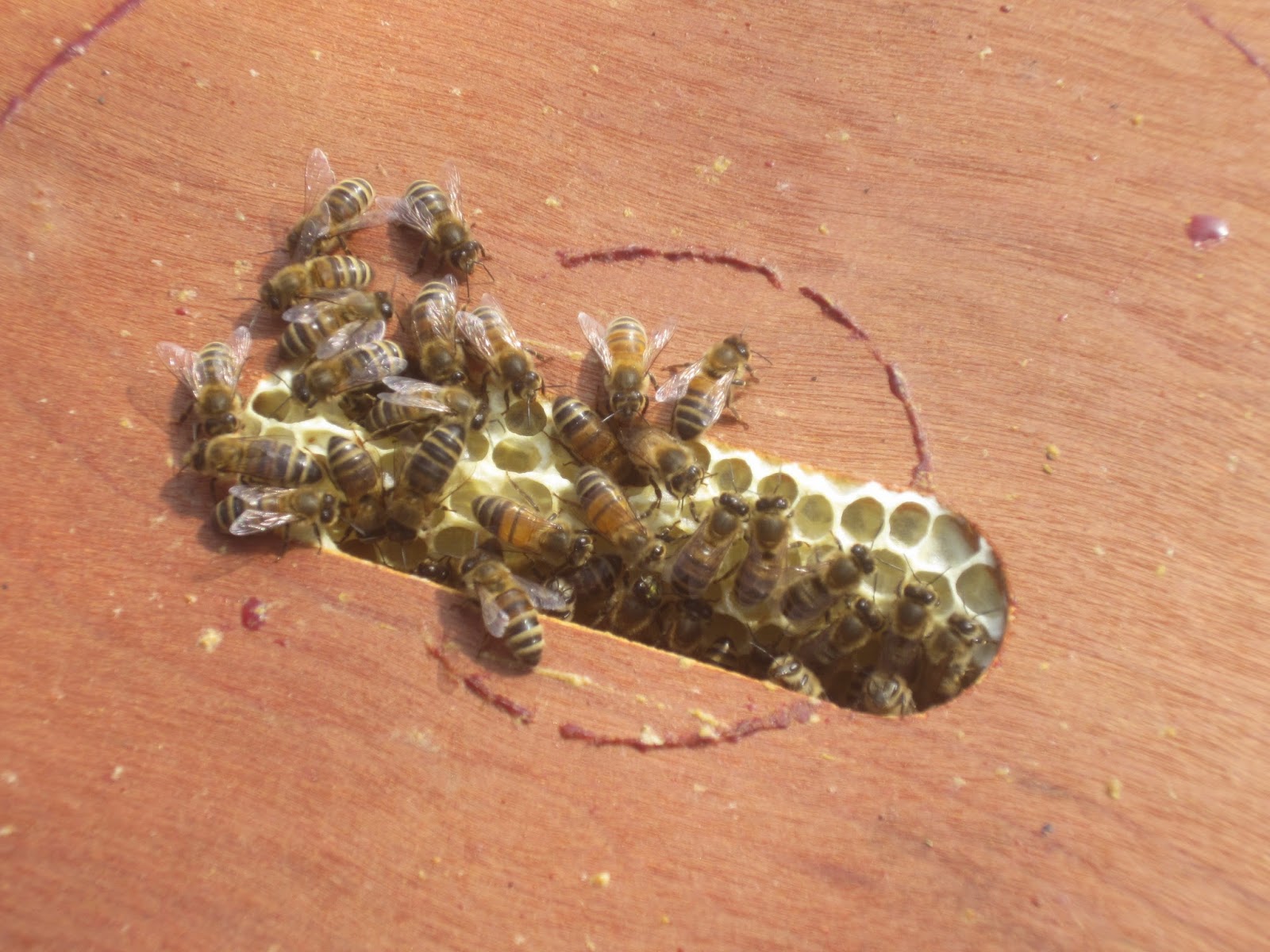
This is not good news!

Goulwenn had great difficulties lifting the crown board off and it soon became clear why.
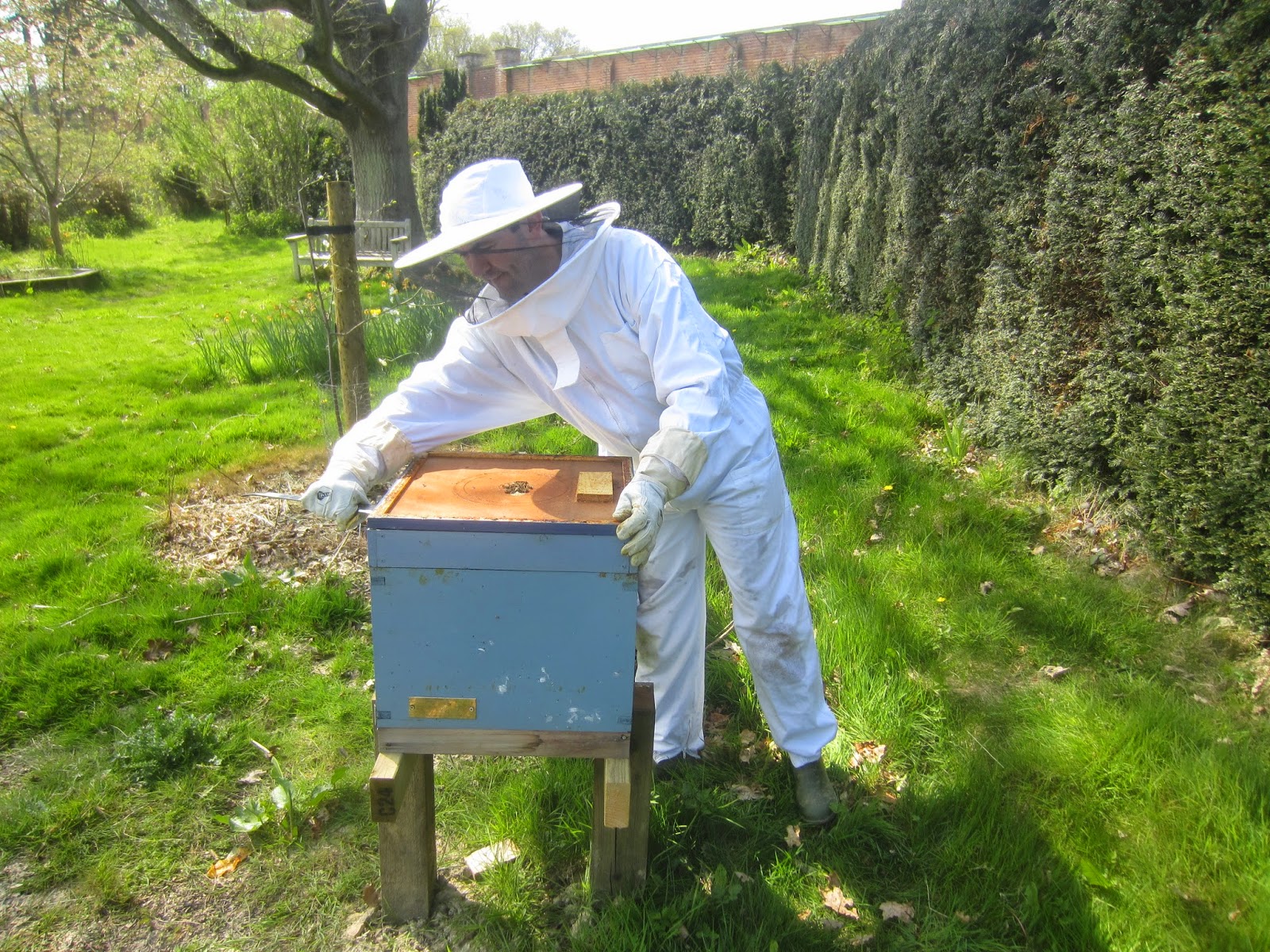
Goulwenn has reached his ceiling!
The reason - wild comb


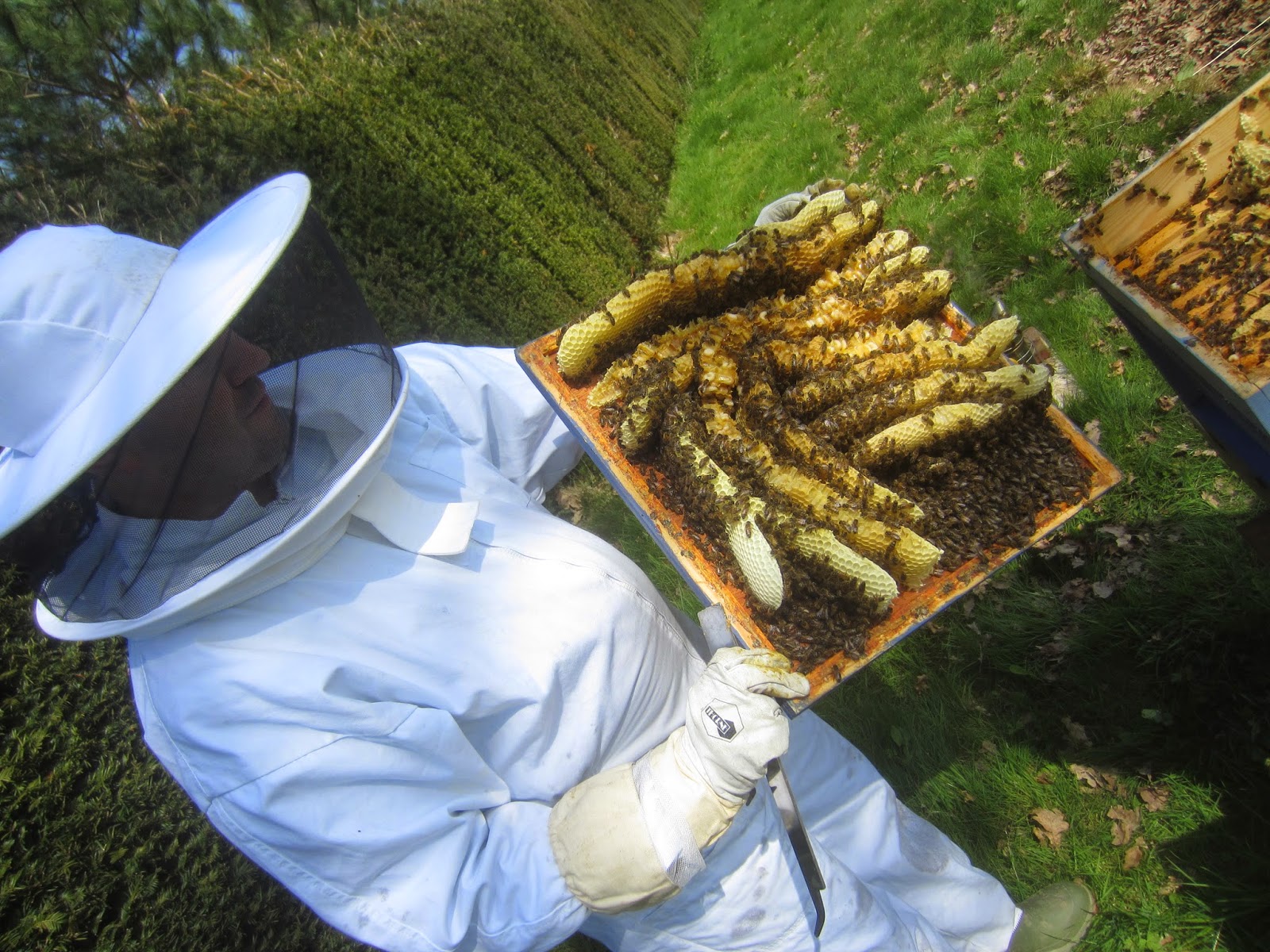
The bees were obviously more active than I thought - and certainly not as lazy as I had been. Although temperatures had not been really inviting, the bees, safe in their Celotexed home, had decided differently and started redecorating the hive. The eke, which is always left on the brood box over winter in case feeding becomes necessary, had been filled by the bees with wild comb. Unfortunately, by lifting the lid, we did destroy some of the comb, with brood in it - but what an awesome sight! This is how bees fill a 40x40cm cavity!
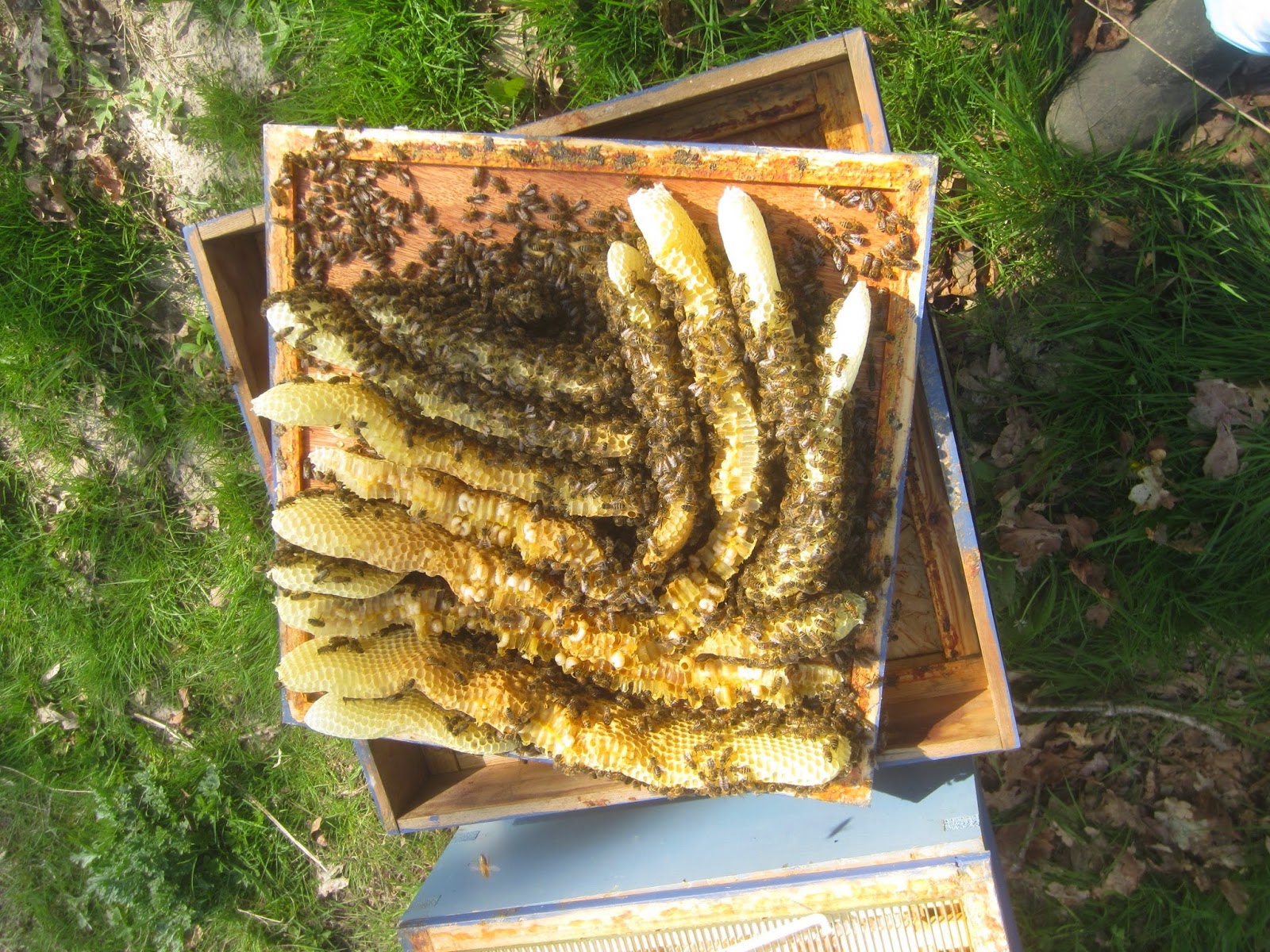
Bees gone wild! This is what wild comb looks like.

Having discovered that, we were then somewhat at loss what to do with the wild comb. We decided to keep it (would be so unfair to destroy it; would also kill too many larvae), but make sure the queen could not lay in it. So, when we reassembled the hive, we put a queen excluder on the main brood box, so the queen will stay in the brood box (we knew she was in there - of that anon), and the wild comb on top of that. When the larvae hatch from the wild comb, which the bees will probably extend further (once you've started a DIY job, why stop in the middle, right?), no new ones will be laid there, so the bees will probably fill the comb with honey. Wild comb honey! Looking forward to that. Anyway, this is what the final set-up then looked like.
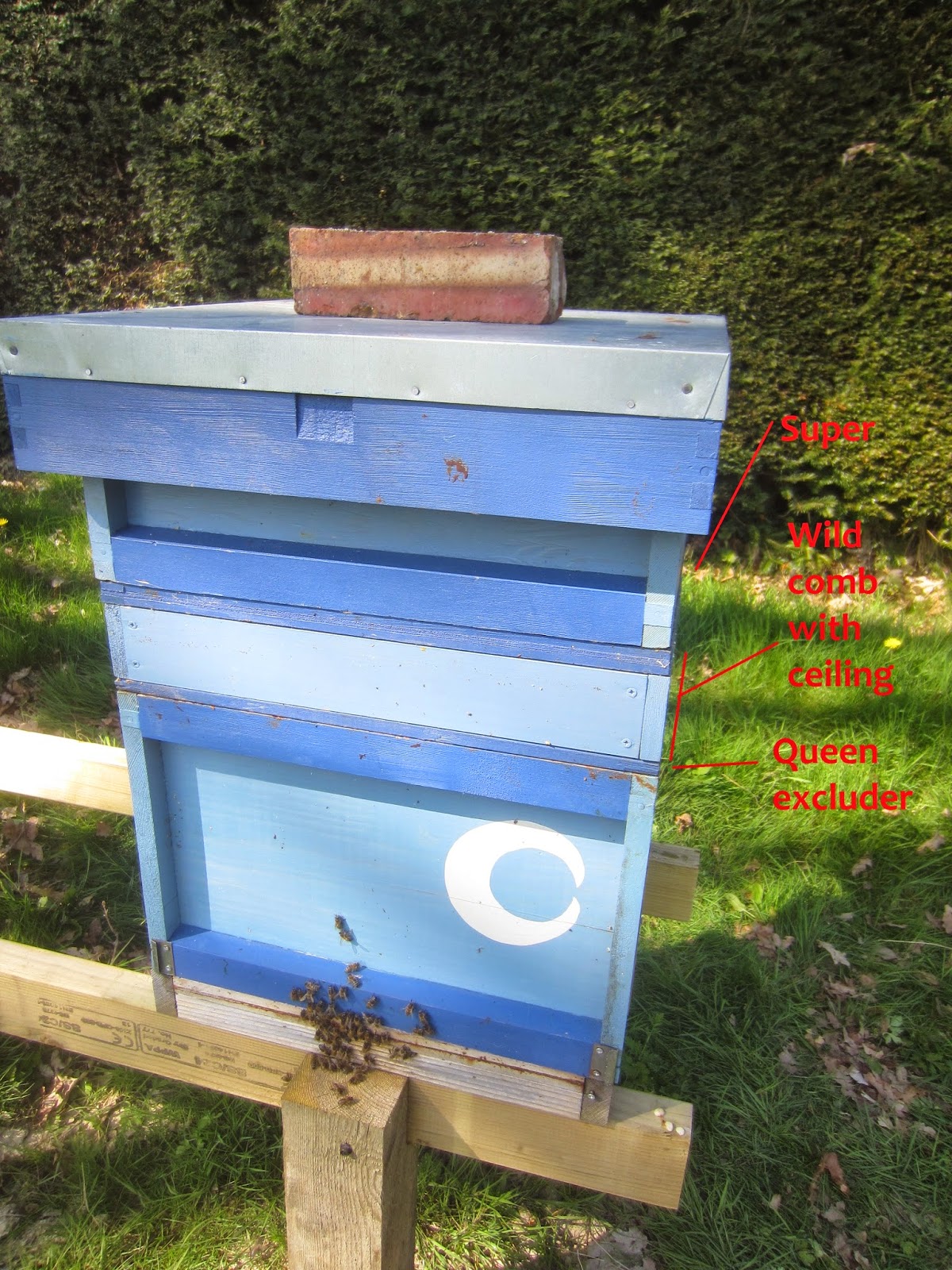
How we put the hive back together again

Goulwenn searching for what is so hard to find
Before we put it all back together like that, we had to find the queen. Never an easy task. I think the last time I saw the Moon queen was some time in 2013. Of course, it was a different queen then.

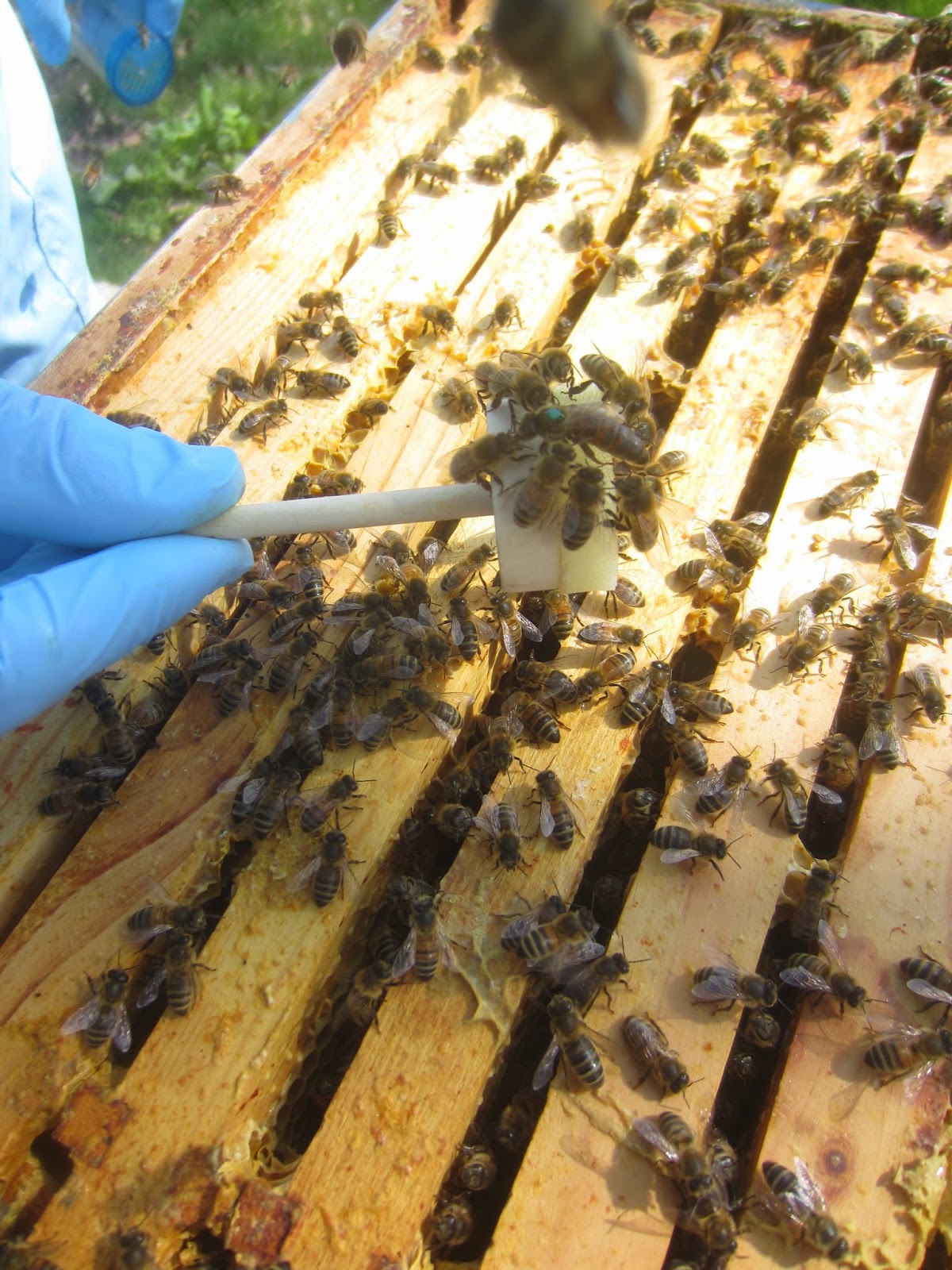
Goulwenn went through the frames once and we both looked - nothing. We decided to go through them again and - amazingly - we saw the queen, scuttling around where we least expected her. She let herself be trapped quite easily and then I put her in the marking cage. While I held her carefully pressed against the mesh, Goulwenn painted a little green spot on her abdomen. All done!
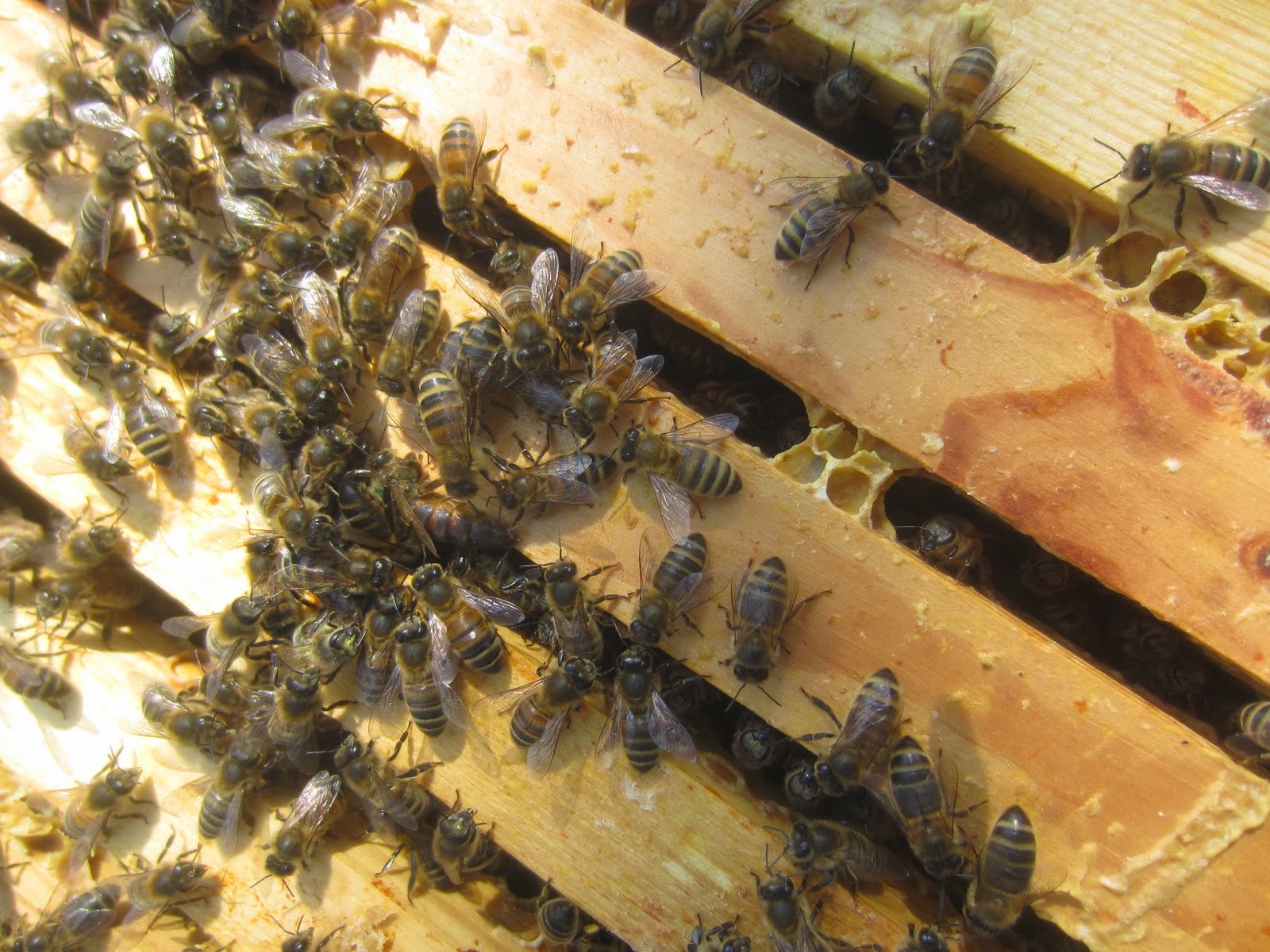
After the marking ceremony, she was reluctant to leave the pad and a court of her bees immediately gathered round. Eventually, she slipped off the pad and disappeared into the hive.
We put a super on the hive, so the bees would have enough space, and then closed all up. A successful, if somewhat unexpected, first inspection.
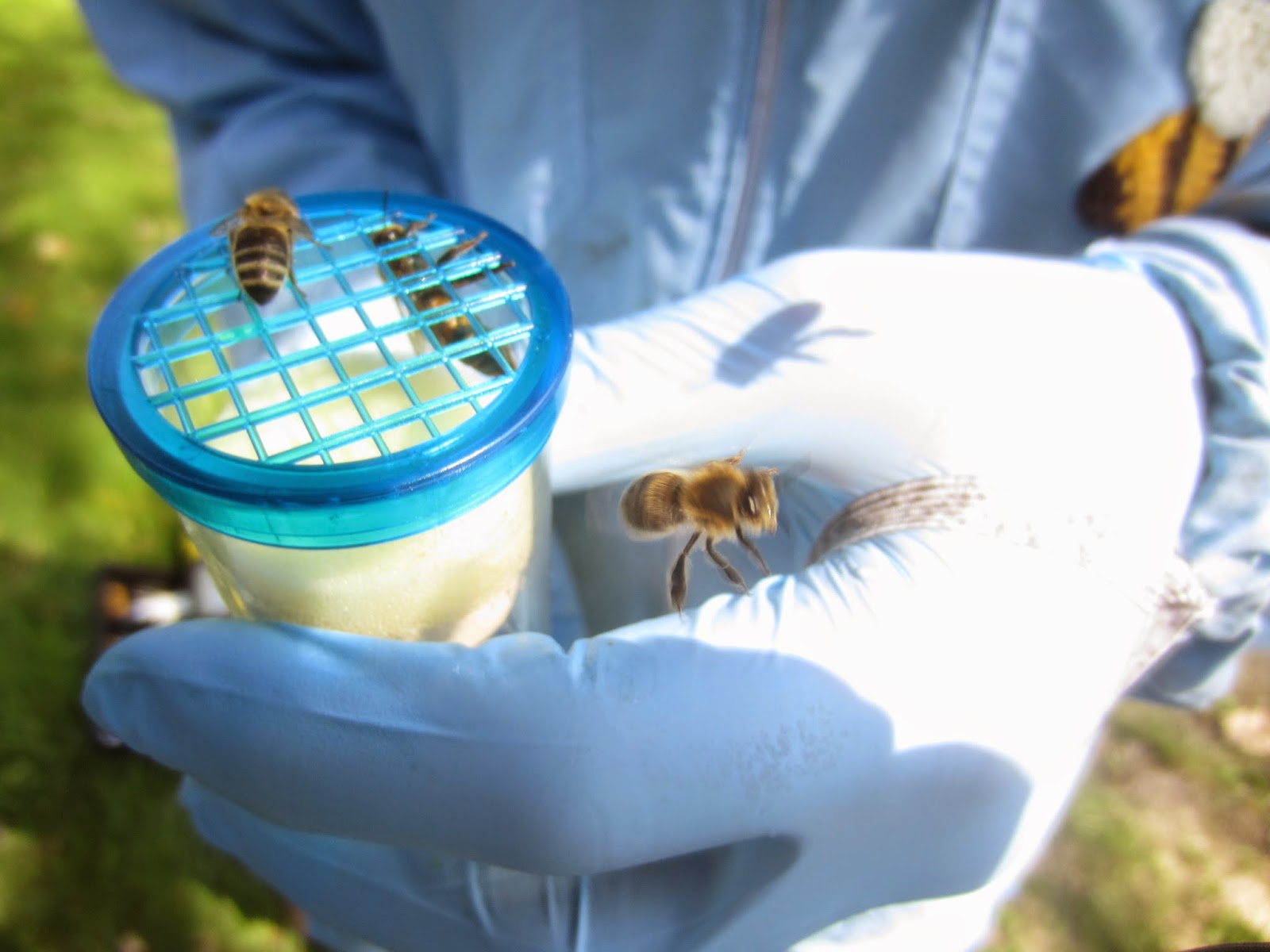
The queen in the marking cell

One marked queen, with attendants

The newly marked queen holds court - on a pad

Queen disappearing down a seam. Can you spot her abdomen?


Friday, 17 April 2015

Maintenance and Repair

The Moon busy again
It's been a quiet winter, so not posted for a while. However, I have been doing little things, but none of them worth posting as yet (there is a larger project in the pipeline, but it's not ready to be unveiled yet).

As the weather is improving now, I decided I need to attend to a number of issues urgently.
First of all I removed the Celotex from the Moon. The bees are out in strong numbers and I think they should no longer need the extra protection. It still gets cold at night, but there is enough forage available for them to eat their way through that, I think. Also removed the mouseguard, so the hive is once again working as usually. As it was windy, I didn't open the Moon up, but intend to on Monday, not least because I have to mark the queen.
Various hive bits in the process of being de-propolized


Second task was to go through all the supers and frames and clean them a bit. I scraped off the remains of the dead bees, wax and - mainly - propolis. It was harder work than I thought, but the hive tool is great (love the hive tool!) and after a few hours all wooden surfaces were tolerably smooth again. At some point I think I should burn the wood slightly (I think that's what they say you should do). Will try that next year.

Finally, I had some repairs to do on the Star brood box and roof. Due it having fallen over, the roof was broken and the brood box slightly damaged, too. Fixed both of those best I could. The equipment is now as ready as it will ever be. Roll on the good weather!
Fixing the Star


Thursday, 15 January 2015

Acid treatment

A bottle of acid
With the weather getting shiveringly cold, it's time for the acid treatment. This year I thought I'd buy the acid in bulk, so I'd have enough to last a few years. So, thank ebay, I had a largish bottle of oxalic acid, which aroused quite a bit of interest from the pupils. However, I have since discovered that the acid does not keep, as the sugar, with which it is diluted, somehow ferments (or similar - can't quite remember what), so will not be good for more than a year or so. Great! So much for wanting to do it all myself.

Be that as it may, I had three keen volunteers, all from younger years so the beesuits trailed on the ground somewhat. Not sure the mud will go out (stains generally never go out in the wash), but it's time to wash the suits anyway.
First excitement of the day was that the hive stand has been completed. So Mr. V and I decided to heave the hive onto the new stand after the acid treatment. No point in getting the bees riled up because their house is moving to then open them up!

The new, sturdy stand - thanks to Chris the carpenter

Opening the hive somewhat more noisily than I wanted to (yes, the bees had stuck everything down properly with propolis), we saw numerous bees inside. They had built some brace comb over the top and seemed to be occupying five seams, which is quite a lot. The store situation looked good. Quite a few bees buzzed around us, but there was no hint of aggression in their buzz, more curiosity. They landed on the pupils, Mr. V, me and the syringe. None stung.

Bees watching the acid drip in

As quickly and thoroughly as possible I dripped the acid into the seams. Although the advice says to move the frames apart a little before doing this, this would have been impossible, as all frames are firmly stuck down. Had I tried, I'm sure the dummy board would have come apart; it has made several attempts to do this in the past and then we would have been nowhere.
After finishing with the acid, we quickly closed up the hive and then lifted it onto the new stand.

The hive on its new stand
Checking the mouse guard, with pupils looking on

Tuesday, 16 December 2014

A new stand

Since wrapping the bees up, it has been quiet around the hive. In fact, I've hardly been down (or up) to the hive, but I hear from passers-by that the bees have been fairly quiet. But while they are having their well-deserved winter rest - just lazing about the house in their slippers sipping honey - others have been busy.
After the catastrophic collapse of the Star stand, I have been wanting to put the hives on firmer supports. So I drew a plan of what I was looking for and persuaded bursary and groundsmen that this is what we needed. Actually they didn't need a lot of persuasion: whenever the bees are concerned I seem to be running in open doors.
The other day I was told that phase one of the new stand had been completed and the posts where firmly stuck in the ground. Bars will be fixed to the posts and the hives then placed on these parallel bars, making all the bees little gymnasts.

The beginnings of a four-poster bed for the hives

While admiring the work done so far, I noticed one or two stray bees at the entrance to the Moon. It was a fine day, though cold, and I guess the bees were just checking that it wasn't spring and they could still go on eating, sleeping and watching hexagons till their eyes go funny.

Two bees checking spellings

Sunday, 30 November 2014

Girls on Film (2)

The other day one of the last bee inspections with children from the school was filmed. You should be able to access the video here:

https://www.youtube.com/watch?feature=player_embedded&v=6MwRCV3BI0c

If that doesn't work, then go on facebook and search for the page of Saint Ronan's School (written thus) and you should find the video there.
Happy viewing!

Monday, 17 November 2014

Lullabee

A complete lie - for once the bees are at rest!
After the last inspection, I thought I'd leave the bees for a fortnight or so, so they could get any and all syrup they wanted to down into the hive. The weather was also quite clement, so I saw no need to celotex them up.
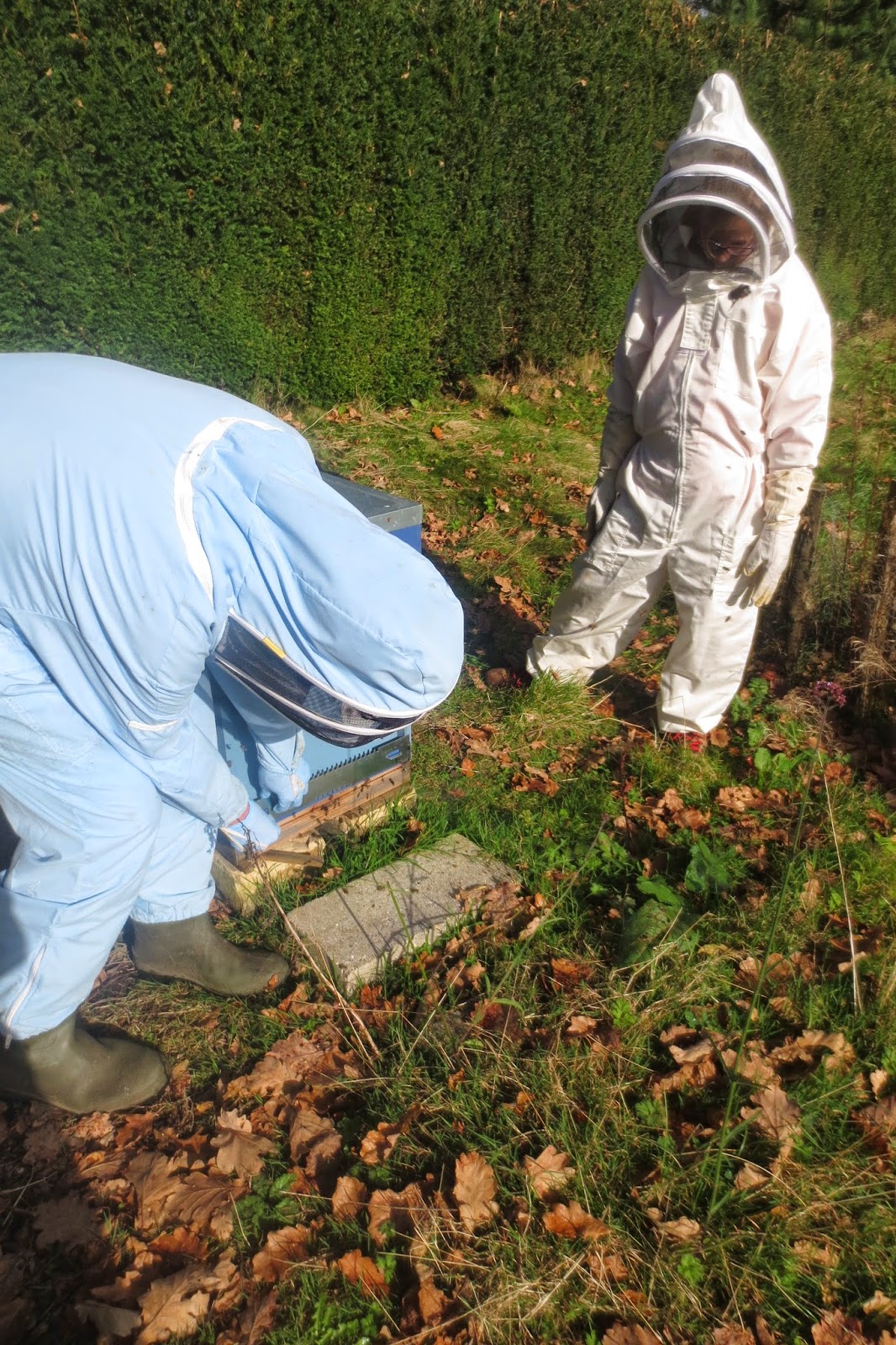
Now the weather has changed to rain rain rain and rain again, I decided it was high time to insulate the bees. I waited for a (forecast) lull in the rain and used that to settle the bees in for their winter rest. Goulwenn was invaluable once again, as he fixed the strap round, while I held the celotex tiles in place.
Before that, we removed the feeder, which was only half-empty, and took off the super, so there's only a narrow eke on top of the brood box. Stores, from what we were able to see, looked good though and the bees have quite clearly stored more.
And that's it for this year. The bees will keep themselves warm over the winter with their honey/syrup reserves and I can use the quiet months to make sure all hive parts are ship-shape for spring. Will, of course, post my DIY successes and failures.

Saturday, 1 November 2014

Niece bees

As in the past few years around this time (see last year's entry), my sister came to visit with one of her children. This time it was Emily who came to pack up the bees - only it was too warm to celotex them already; besides, I still felt they needed to build up more stores.

The contact feeder uncontacted
Instead of wrapping the bees up, we therefore opened them up to get a good view of what's going on. Emily was fearless amid the bees, who were, if truth be told, very calm and relaxed. Removing the feeder was a slight challenge as always, as the bees waxed it to the frames (funny that they never propolize the contact feeder to the frames), but not really hard. At risk of sounding like a broken record: the bees had not taken a lot of the syrup, though surely foraging can't be that good (we did see two bees with full pollen baskets). Refilled the feeder for their final feed and aim to take it off in two weeks' time, which will hopefully give the bees enough time to store all they need or want.

To get an idea of their stores, I decided to do a full hive inspection. I also wanted to see how much the queen was laying. Luckily by this time the weather had hugely improved and the bees seemed to be enjoying the sunshine. As relatively easy as it had been to remove the feeder, it was almost impossible to take the frames out of the brood box: the bees had stuck them all down so thoroughly that the dummy board was in danger of splitting rather than coming out. In the end I managed, but only just. Will have to give the frames a proper clean-up come spring.
Checking the laying pattern


As to be expected, most frames were full or almost full with stores, though the bottoms of many frames were still bare. Only two frames had brood on them, showing a much reduced activity by the queen, who we didn't see, as Her Royal Beeness was hiding in the shadows.

Before putting the feeder back on the frames, Emily smoked the bees to make sure I wouldn't squash any (smoke makes the bees run and hide).

After having closed up the hive again, I installed a mouseguard. Although the weather is still warm, it is bound to change soon and as I don't want any mice thinking the Moon is a perfect place to spend their winter holidays. Now they can't get in, so won't.

Putting the feeder back on


No entry sign for mice


Thursday, 23 October 2014

A Star goes out

The Moon feeder in situ
I had wanted to remove the remains of the Star earlier, but somehow never managed to find the time. A call from the school office telling me the groundsmen were having trouble with the bees flying around the hollowed out Star forced me into action. With the ubiquitous Mr. V and a large rubbish bag we went to sort out the Star.

First of all we checked up on the Moon and refilled the feeder. Once again the bees had not taken much. Obviously there is still sufficient forage for them. Nevertheless, we filled the feeder brimful again.

After a few days of rain, the Star, open-roofed as it was, presented a more unsavoury sight: some of the wood had started to mould and the larvae (some of whose cases I had opened last inspection) were putrid. The smell was rank and would have been the match of the most seasoned garbage collector. For the first time the similarity of the beesuits to hazmat suits made sense.
Hazardous waste
Contrary to the alarmed accusations of the groundstaff, not a bee was close to the Star (sensible little creatures) and I don't blame them! Instead, cohorts of wasps hovered over the frames, unruffled by the smell. Holding our breath as much as possible, I cut around the frames to separate the rotting, mouldy wax combs from the wooden frames, which can be re-used after some cleaning. Giving free rein to my hatred of wasps, my hive tool also cut a few of them in half. Miraculously not a single wasp stung us. The gruesomely smelling wax we binned. Even Mr. V, who is no doubt used to the sharper edges of French cheese going slightly biological, found the odour épouvantable.

When all was cut and binned and tied up we stored the brood box with the empty frames in the beekeeping shed. Over the winter I will work on them and make them shiny and new and clean for re-use in the spring. Much like in The Return of the Jedi, the Star will be reborn.

The Star waiting for better days

Friday, 10 October 2014

Girls on Film

The school has decided to go all out on social media and the stars of the first facebook film are to be the bees. Selecting two pupils who have been beekeeping before, Mr. V and I went to the hives to fill up stores, if necessary, check up on the Star debris and show off the bees a bit for the cameraman (another teacher). The whole inspection was filmed, though in about 14 separate shorter clips, as the bees kept on showing too much interest in the camera, forcing the cameraman to stop filming fairly frequently. I hope their new status as stars doesn't turn my lovely little bees into temperamental divas!
The bees had not taken a lot of the stores, but we replenished what was gone. A quick look at some frames showed that all is fine with the Moon. Not all frames are full with stores yet, but then I didn't expect that.
The Star frames still have some honey on them and we spotted quite a few bees buzzing around them. Although a number of wasps made their presence felt (and also felt the edge of my hive tool), I decided to keep the Star box and frames out for a little longer.
No photos, as I expect a film on facebook!

Friday, 3 October 2014

Refill

Once again I only had time for a very short inspection. That was ok this time as I only wanted to fill up the feeder, having spent last night stirring syrup. The bees have not drunk much of the syrup. I think they are mainly emptying the Star brood frames of honey and pollen; when I checked these it was obvious that bees had been been removing the stores from here.
No photos as on my own and stressed (house singing competition again!).