Thursday, 13 March 2014

Moon take-off

With the weather improving, I thought I'd take a look to see what the bees are doing. As there were a number of jobs that needed doing, I decided to inspect each hive on a different day, starting with the Moon. This would also increase the number of pupils that could come out to see the bees.

However, Wednesdays are match days, so there were in fact no pupils that came out. Hrumpf! So much for wanting to involve more pupils. The first full inspection of the new season was therefore a very quiet affair: just another teacher and I.

If truth be told, I was slightly apprehensive about the first inspection. Have browsed through photos from last season, I realised again how many bees there are in the hive. I was a bit worried that I wouldn't be up to it, that I might panic, that the bees might be unsettled. Nothing of the sort. The bees were sweet as ever (I do love them!) and were unruffled by me putting my fat (well, not really) fingers in their home. I didn't even use a smoker (just had it ready as a back-up, in case), and they were lovely and calm.

The latest skyrise at Bee Wharf
So what did we do? We checked stores (lots and lots: at least four frames front and back still full of honey or syrup), checked for the queen (whom we didn't see, but lots of eggs and larvae, so she is busy laying), removed the cladding, the mouse guard and the fondant, put the bee gym in the bottom of the hive and re-jigged some frames. I am still battling with the fact that the original nucleus came last year with too short frames. This time I took out two short frames with honey stores and replaced them with fresh long frames. This should keep the bees busy (they are showing ambitious architectural tendencies: when I opened the hive, they had built a honeycomb dome and were busy trying to build more) as well as bring a bit more order to the hive. The honey will not be lost, as I left the frames in front of the hive, slit open, so the bees can find the honey, collect it and store it (again). I wonder how much of the outside honey will be left tomorrow, when I go to inspect the Star.

Scratched comb stores waiting to be collected (again)


Have just seen the weather report. Apparently there are sub zero temperatures coming our way again. Will replace the cladding on the Moon tomorrow, when I inspect the Star. Don't want the little darlings to freeze.

Thursday, 6 March 2014

Going to the gym

Although I am one of the madder part of humanity, which spends far too much time in a gym in an unlikely attempt to get fit, the title is not about me, but about the bees. Today two contraptions known as 'bee gyms' came through the post. Various modules are spread out on the square frame where the bees, by climbing through them, scratching past them or rubbing over them, can remove varroa mites. Apparently they like this and will use the gym (although in my humble opinion the gym is more a scratching post than a gym). While I am slightly skeptical, I am also prepared to try anything that might keep the varroa count down. So next time I inspect the hives - first inspection of the year, with pupils, of course! - I will add these little pieces of health equipment.

Parallel bars, wooden horse, frames and scratching areas - all in a bees' gym

Monday, 3 March 2014

Hang 'em high!

Space invaders
Beesuits are unwieldy at the best of times, but for children they seem to present an utter labyrinth of clothing mayhem. It starts with the pupils having boots on already to get to the apiary and then trying to get the beesuits on without taking the boots off (has no-one told them you put shoes on after trousers?!?). Then as the suits are large and flappy, they tend to trail them over the floor of the shed or the ground outside. With the muddy weather over the winter this has meant that the inside legs of the beesuits as well as their exteriors have become soiled. So, before the new season gears up and becomes hectic, I thought I'd wash the beesuits. I added plenty of soda crystals to the powder, because apparently that can get rid of the propolis easily.

Hung the four suits up to dry. Luckily that was not in my bedroom. Can imagine waking up at night and suddenly thinking four people have invaded my room before realising it's only the suits. Can do without that kind of interruption to my scant repose. Need to do better than sleep fitfully, as a wise friend of mine would correctly remark.


Thursday, 27 February 2014

Washout

I know bees are busy, but I'm not sure they are patient. After my last entry, we had frost that stuck my car door shut in the morning and sheet rain this morning. The bees cannot be happy. While I imagine they are using the short interludes of sunshine to quickly buzz around, they must be more frustrated than anything. Lucky they have it warm in their hives - and have some candy fondant to eat. Not sure, but I can imagine all those little workers stuffing themselves with sweets in their frustration.

Rapidly cleaned feeders
Anyway, I have started  to prepare equipment and check everything is in good order. I started on the rapid feeders which I hadn't really cleaned since taking them off the hives last July. Big mistake. In future I vow to clean feeders immediately after use. Propolis was everywhere and it was only after an extended soda crystal bath that I could get the feeders anything approaching clean. They still aren't perfect, but will do.

Talking of cleaning feeders immediately: I saw some green fuzz in the contact feeders, so fungi are obviously feeding on the rest sugar in there. Yes - I really must clean the feeders immediately after use and I will in future.


Monday, 24 February 2014

Thunderbirds are go!

Having not had a single decent day since the year began, the recent spate of sunshine has obviously led to a huge catch-up exercise by mother nature. A very wise friend of mine, who spends more time outdoors than I do, had already commented on bees flying about. So, with temperatures mild and the sun balmy, I went to check whether the bees were out and about. And they were!
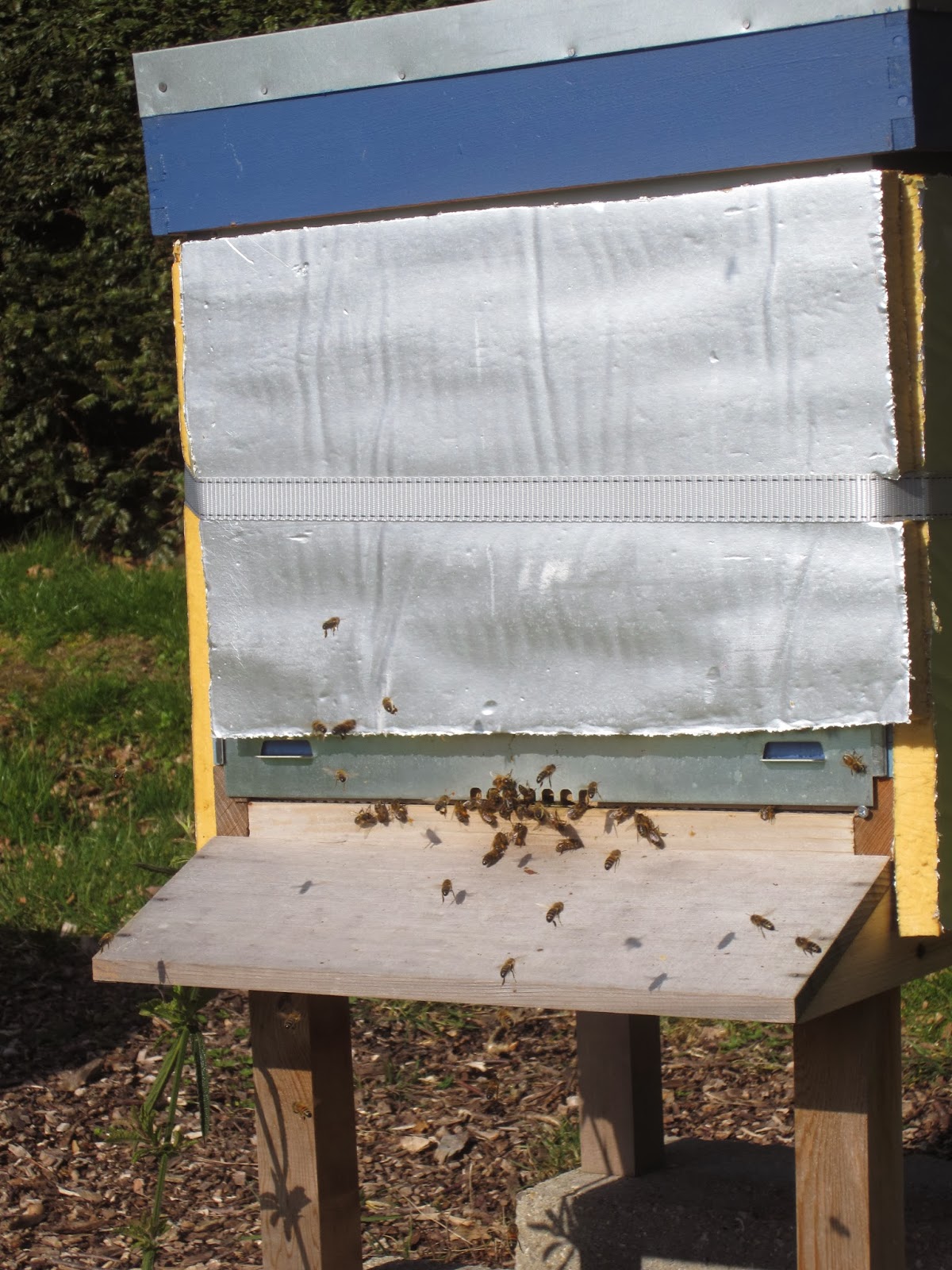
The Moon is picking up where it left off and is once again out to prove it is the better colony. Many bees crowded around its entrance and I saw some carrying pollen. The Star also had workers out, but not as many. So slightly more sluggish, as last year.


Star still slow going
The Moon takes the lead

But I am excited that the bees have taken to the air and will now have to make sure that all is ready for whatever antics they get up to. If the weather holds I plan to inspect the hives briefly next week and will probably start syrup-feeding them again, so number go up ready for the first honey flow.

Wednesday, 29 January 2014

Acid rain

With the cold weather the queen should have stopped laying altogether, or drastically reduced the eggs laid per day. This means that the varroa should mainly be on the bees, which is apparently the perfect chance to zap them with some oxalic acid. From what I know about acid, however weak, I can't imagine the bees like being sprayed or dripped with acid, but apparently they deal with it better than the mites, that just drop dead (oh, how I wish they all would!).

They say you learn from your mistakes - it's a lie (to quote Vaya Con Dios). Having once been unsuccessful in my attempts to access the bees without a beesuit (when I wrapped them up for the winter), I didn't think that it might be better to start out with a beesuit right away. There is something about the baggy blue boilersuit that makes me not want to put it on. Must be to do with getting legs and arms trapped in opposing sleeves and legs and being semi-strangled by the garment. Anyway, I did without it, believing the bees to be dormant, semi-frozen, huddled around the honey, having a nice winter meal.
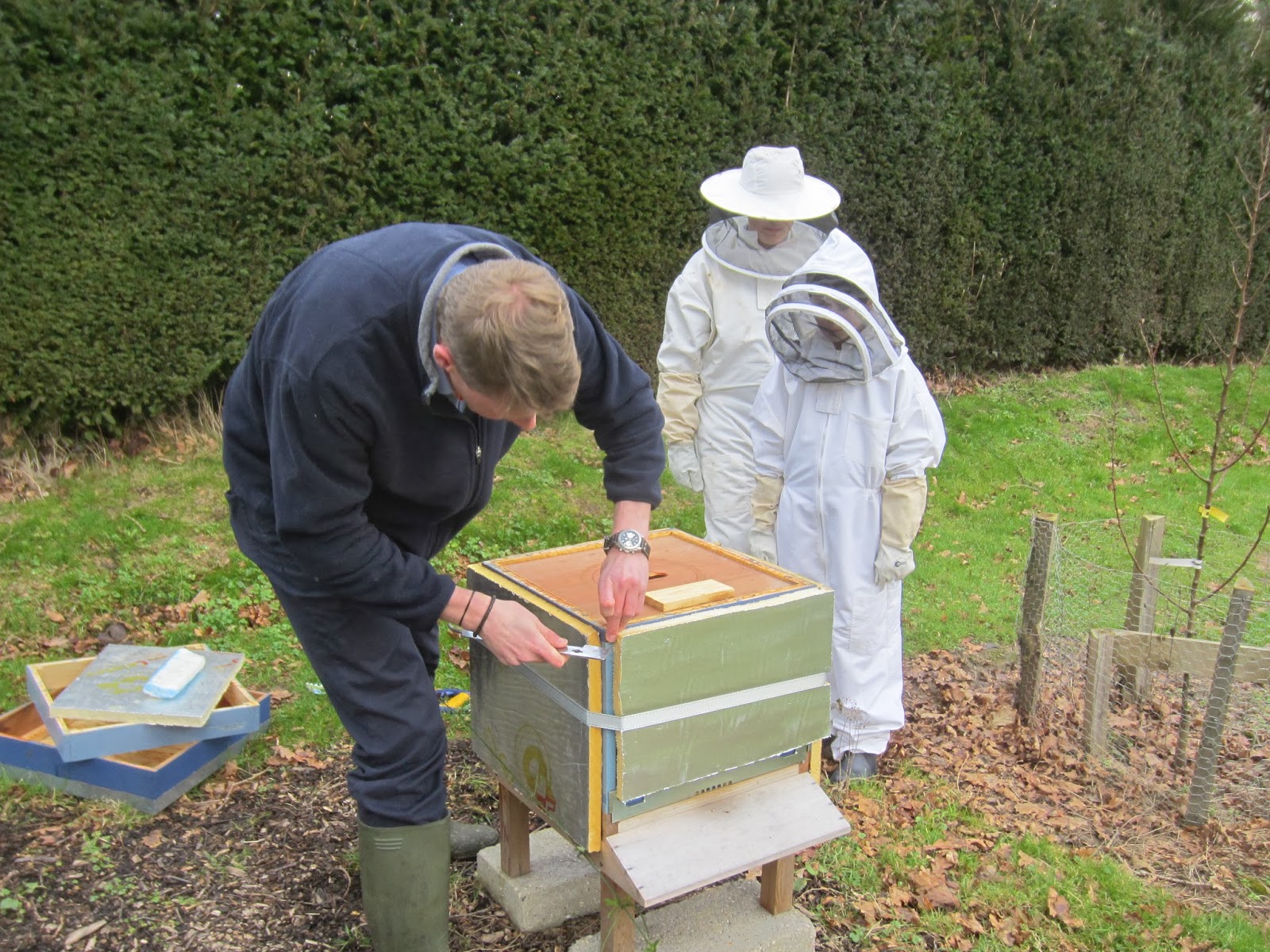
Only fools rush in
Opening the hives was not easy as the bees had done a thorough job of sticking the crown board down and the insulation I had strapped on gave little purchase to the hive tool. As soon as I managed, the bees flew up and out. So much for huddling somewhere warm. They were not particularly fast or dangerous, more Sopwith Camel than Fighting Falcon, but even the Camel can get dangerous. There were also so many of them that I felt a retreat to reclothe might be wise. While not aggressive I was not sure how they would react when a syringe filled with acid approached their home, hive and castle, let alone how they would take being soaked in acid. Not without a fight, I imagined. Once again it was great to have pupils along, as they held the fort while I battled the boilersuit. Them I had of course dressed in beesuits right from the start.
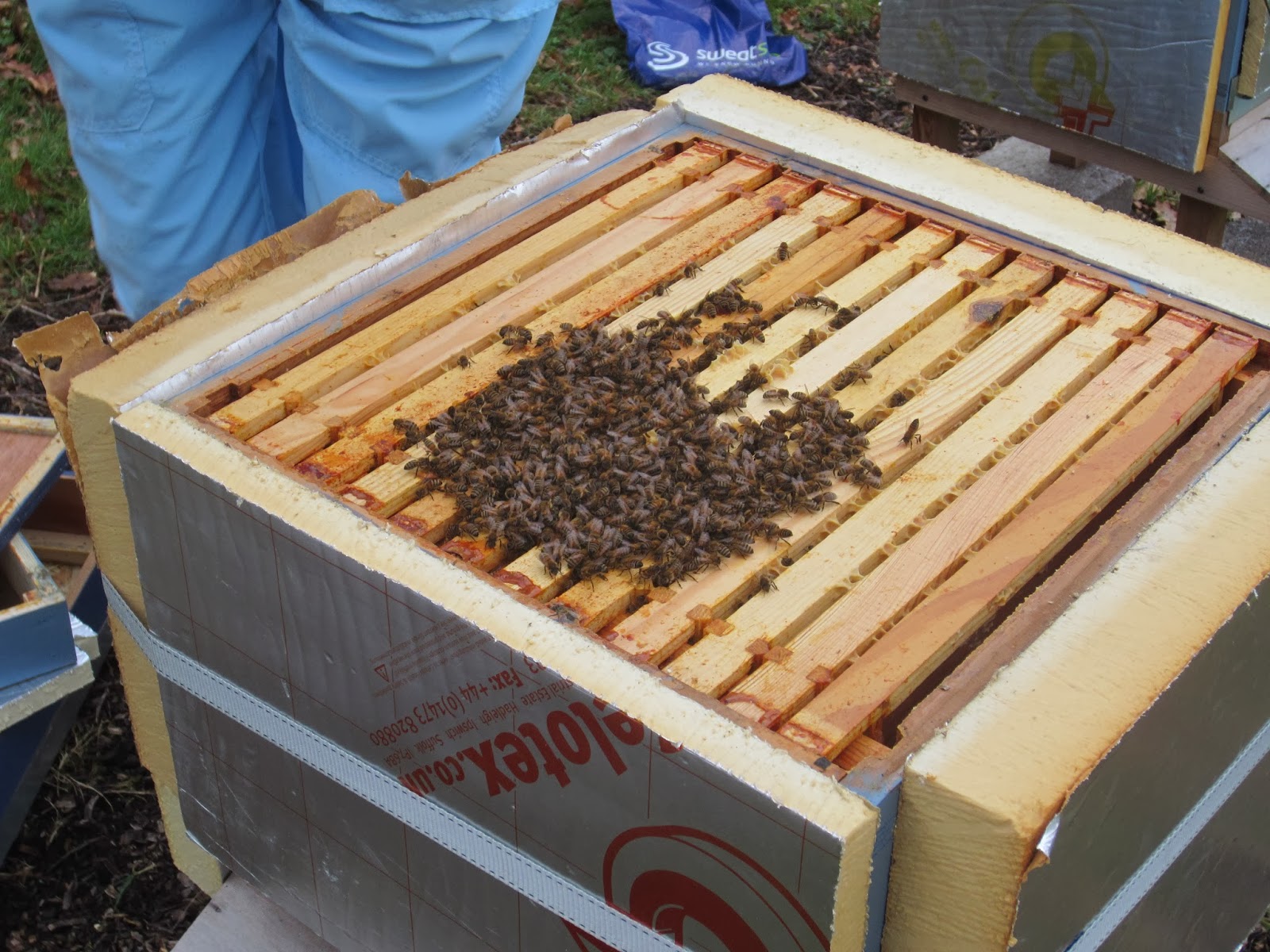
Bees not where they should be
Back at the hives, I dripped the acid into the seams between the hives. It should be 5ml in each seam, but even though I had pratised getting the dosage right in the kitchen sink, it was a bit more difficult on site, especially when the volume markers are turned away. I managed well enough and I hope the bees will forgive me the fractions too many dripped in some seam and the varroa take the hint in the seams underdripped and die nevertheless.
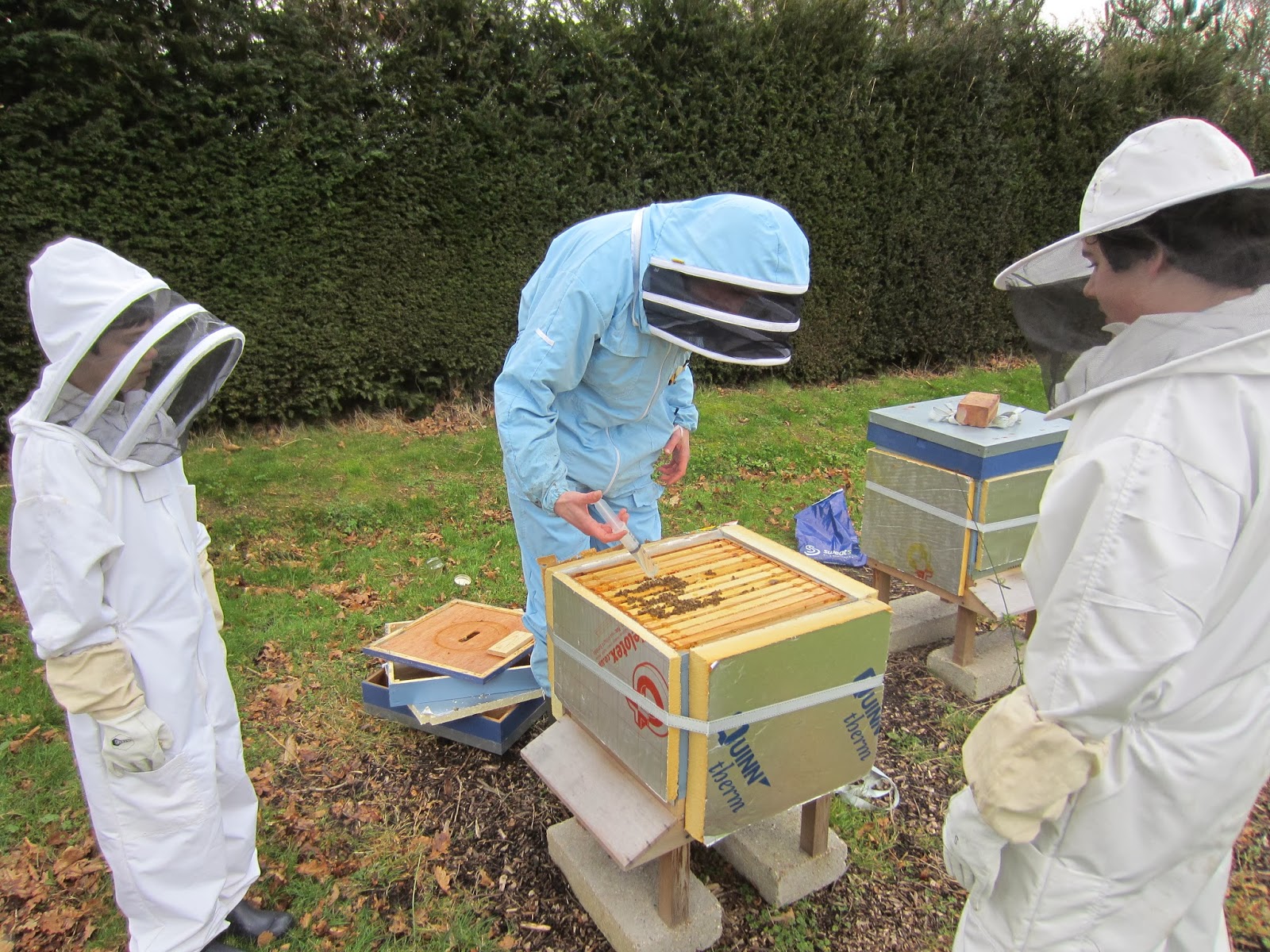


Chemical warfare
Finally I placed some fondant on the frames, just in case the bees run out of food. While the hives felt heavy and the bees looked healthy, I don't plan on going into the hives till March, so in case their stores don't last till then, they have the fondant.
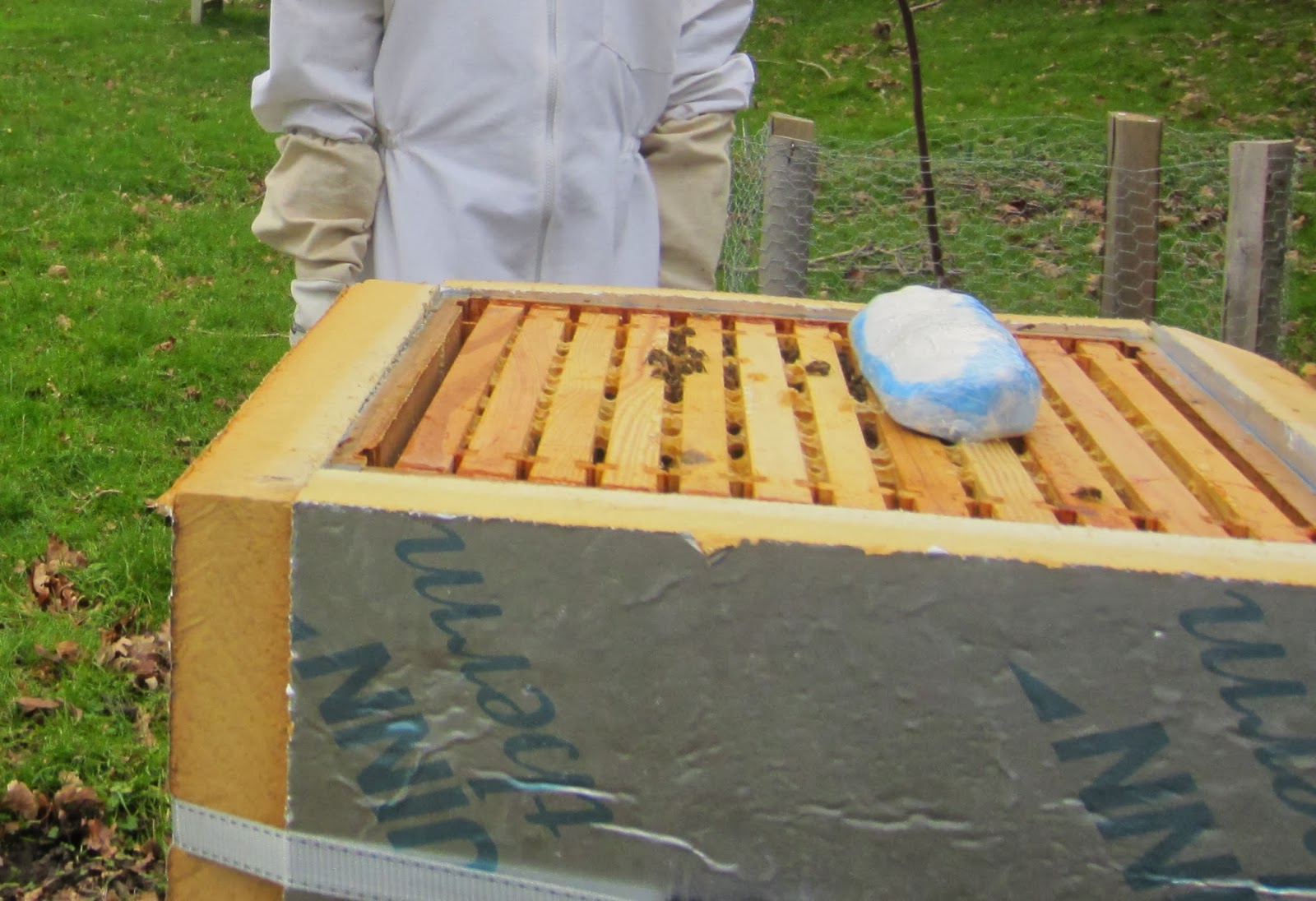
A packet full of fondant

Fingers crossed that all goes well till spring, if spring decides to come to this green and pleasant land.

Tuesday, 28 January 2014

Hefting

My first attempt at hefting - the watch is not obligatory
Hefting is an arcane art practised by beekeepers in winter, by which they grab hold of the hives, lift them a few centimetres above the ground and with much screwing up of the brows and hmmm-ing and aaahhhh-ing can calculate to the precise hexagonal cell how much honey the bees still have stored.
Apparently all it takes to be able to do this is time and practice.
Wanting to be a real beekeeper, I decided that I, too, must heft the hives. So I lifted the hives, which was not quite as easy as it sounds, because they somehow seemed to stick to the bricks they stand on. Having managed that, I screwed up my brows and hmmm-ed and aaahhhh-ed, but I had no clue how much honey the bees had. Both Moon and Star felt heavy, but then the hives themselves, being of wood, are probably quite heavy when empty. To cut a long story short, I am clueless. Perhaps the more often I heft, the more clue I will gain. Let's hope that's the case.
So, no matter what weather, it will be a hefty winter.


In a right lather

With the honey gleaned by hanging, I decided first of all to try and make some soap. For some reason the idea of honey soap had stuck in my mind and when one of the beekeeping magazines I get sent had a recipe in it for fast-hardening soap I thought I would try that. I even emailed the author, Dr Sara Robb, for more information, which she kindly supplied. I had no idea how long the process would take, so set aside a whole afternoon. I had previously acquired some moulds: honeycombed and a small elephant, as well as a baking tray for the good old square stuff.
Making soap is quite easy, but you need a few ingredients, namely three different types of oil, a mixer, caustic soda and scales, because the weights are important.
Let's make soap!

So, all equipment and ingredients prepared, I set about making soap. I prepared the lye, which is a mix of caustic soda and water, which it is better not to breathe in. While that was being nasty in its little glass jug, I mixed the oils and then mixed all together with the aid of a mixer. As soon as that was done it was simply a case of pouring the resultant custardy fluid (not that I would have wanted to taste it) into the moulds and making sure it was warm.

Wrapping the moulds up to keep them warm


To effect this I wrapped all up in towels and towels and towels. Unfortunately, as I did not know how quickly the saponification (as it is known) would take, I think I may have exposed the solidifying soap too early to the cold air of my kitchen, so that the soap did not congeal as it should have done.
At least that's what Dr Robb said when I somewhat disappointedly sent her the photos of the unevenly coloured bars of soap.

Unevenly coloured soap


Another thing that disappointed me was the fact that the soap did not at all smell of honey, although I had put in a generous helping of Ronian honey. Dr Robb (my agony aunt in this matter) said the honey in the soap recipes (yes, soap making comes in recipes) was mainly for reasons of moisturising and not for fragrance. If I wanted honey fragranced soap I would have to put in honey fragrance, as the amount of honey put in is too little to affect the aroma.

What all that means, I guess, is that I'll have to make another batch of soap. While the first batch was fine - it was all good soap and brought out a nice lather - I do want to make some improvements for the second lot. But the whole venture was exciting and if I continue in this vein I will soon join my local WI branch!

Sunday, 5 January 2014

More honey

Although all the honey has been jarred and auctioned off, I had two sacks full of wax cappings mixed with honey from my honey extraction. It is possible to extract this honey, though it is generally said not to be of the same quality as the 'normal' honey directly from the frames. I guess this is because it might have more wax particles in it. However, that honey, I thought, should be ideal to make some other honey products.

I had been saving this honey to extract at some point when all the fuss has died down when I would also have some time to devote to making whatever products I fancied.


So, over the winter, I first of all extracted the honey. This basically meant hanging the plastic bags with the cappings and honey into a fine meshed bag, cutting the plastic bag and letting the honey drip through the muslin. This was a slow process, each bag taking a whole day to trickle through, but it did yield a bit of honey that I was able to use for other purposes (of which later). There is still some honey with the wax and the next step is to purify the wax so this can be used to make polish, candles or whatnot.

Even though the bees are resting, I'm not! But I'm not complaining: this is all fun and I'm working nowhere near as hard as the bees did throughout the summer. They deserve their rest.

Monday, 30 December 2013

Watershed

For those of you who don't live in Kent (which is the majority of the global population, which is, of course, all reading this blog), you may not know that we've had abysmal weather of late. In fact while I was holidaying in Vienna, winds and rainfall became so strong that most houses around mine lost power and my shed was blown apart. Before that the door, admittedly, was coming to pieces, but it was nothing like it is now.

This used to be a shed

So with the wind doing this, I was slightly apprehensive what might have happened to the hives. I had visions of upended hives, frames scattered about the place and bees somehow half in, half out, dazed, cold and dying in an incorrectly furnished and orientated hive. I really didn't know what to expect. You can imagine my relief when I found both still standing as if gale force winds hadn't taken down the electricity in half of Kent and brought South Eastern Rail to a standstill (ok, that's not such a major feat).

The hives: as happy and unruffled as lunar modules after landing

Sunday, 10 November 2013

Shedloads of work

With the foul weather we've been having lately, it came as small surprise that the shed in which I had stored the bee equipment (I had usurped a corner of the shed of the school's gardening club) was not quite as waterproof as one would like it to be. Also, conditions being rather cramped, I was on the lookout for a special shed to keep just the bee equipment in and dry. There is a shed next to the gardening club shed, but this had always been used to store sport equipment. When I heard they were moving out, I bagsied (shot-gunned) the shed and the maintenance department did a splendid job re-roofing, re-flooring and re-windowing it. And now we have our very own bee shed.

Many times have I mentioned the advantages of working in a school environment. Getting the shed is just another example. And for those of you who aren't sick yet of me going on about how great it is to be beekeeping in a school, here's another example: I was on my way to the shed to transfer all the equipment from old to new, when two pupils came to me, asked me whether I was going to the bees and could they join and help me. There are always little helpers around, so a special thanks to JP and Lewfinn for helping to move the bee equipment to the new shed. Without their aid the move would have taken longer and would not have been as fun as it was.